Wednesday, August 1, 2018

Investors who have pulled billions out of stocks may be making the wrong call amid tech sell-off

The slaughter of consumer internet stocks Facebook, Twitter and Netflix has led investors to run scared of technology stocks in software and semiconductors that have actually done well. But this may cost them.

Reflections of people are seen in the windows of the Nasdaq offices in Times Square in New York. Don Emmert | AFP | Getty Images Reflections of people are seen in the windows of the Nasdaq offices in Times Square in New York.

On Monday investors pulled $1.3 billion out of the Invesco QQQ Trust, a broadly focused technology fund that follows the Nasdaq 100 index. And in the past one-week period through Monday, they yanked $2.4 billion from the ETF, three times greater than outflows from any other equity ETF in the past week, according to XTF.com. In semiconductors, the investor outlook is mixed, with almost $300 million of new investor money coming into Van Eck Market Vectors Semiconductor ETF (SMH) in the past week, but the only semiconductor ETF that was positive in the past week is one that shorts the sector. Of the 51 tech sector ETFs tracked by XTF.com, only two had significant positive flows in the past week, SMH and the broad Technology Select Sector SPDR (XLK).

Now some Wall Street experts are making the prediction that this tech sell-off is the signal that the long reign of growth stocks over lower-priced, slower-growing value companies is ending. But the sell-off seemed to run out of steam on Tuesday, as the Nasdaq rebounded, up near 0.6 percent at the close, and Apple reported strong results for the fiscal third quarter. Apple stock was up 4 percent Wednesday morning and the Nasdaq continued higher in early trading.

The debate now is whether investors acted too quickly to unload what has been the dominant group of stocks in the market since the last recession.

The top of a fund's holdings list matters

As measured by the Invesco QQQ Trust, an ETF that tracks the Nasdaq 100, the drop in tech stocks since Facebook missed second-quarter earnings forecasts on July 25 is about 2.5 percent. But nearly half of the QQQ's holdings are in Apple (11 percent), Amazon (10.5 percent), Microsoft (10 percent) and Google parent Alphabet (9 percent), the only four stocks that represent more than 5 percent of the fund. Facebook was next at just under 5 percent, as of July 30.

Some tech stock ETFs have been hit hard for the right reasons, such as the Global X Social Media ETF (SOCL), down more than 9 percent in the past week. With large-capitalization tech stocks central to market gains for the last year, the Netflix drop of nearly 9 percent, and Facebook decline of over 21 percent, are not surprising after each missed consensus forecasts.

The hottest tech ETF, the First Trust Dow Jones Internet Index ETF (FDN), was down more than 6 percent in the week through Monday. As of July 30, Facebook and Netflix were its third- and fourth-largest holdings, after Amazon and Alphabet. FDN has taken in more this year than any other tech ETF, over $2 billion in positive flows from investors.

But Amazon has dropped more than 4 percent, and Alphabet has lost nearly 5 percent, even though those companies met or exceeded analyst expectations for second-quarter profits.

"Great opportunities can surface when investors overreact to short-term setbacks for companies. That has happened with Amazon.com and Google (Alphabet) countless times just in the nine years I've been managing the portfolio." -Ken Allen, manager of T. Rowe Price's $5.3 billion Communications and Technology Fund (PRMTX)

Market history shows evidence of tech rebounds after big declines. Tech stocks declined by more than 5 percent over three consecutive sessions through Monday. According to hedge fund analytical tool Kensho, since the end of the financial crisis in March 2009, the NASDAQ Composite dropped by at least 1 percent in three straight sessions on five previous occasions to current tech sell-off. After these drops, the Nasdaq rebounded sharply over the next month, up over 5 percent and generating a positive return in all five instances.

Even amid the heavy tech selling in recent days, the NASDAQ remains on pace to end up for the fourth-consecutive month, with a 2.5 percent return in July.

Bill Miller still likes Facebook

Famed value investors such as Miller Value Partners chief Bill Miller and Ken Allen, manager of T. Rowe Price's $5.3 billion Communications and Technology Fund (PRMTX), argue that technology and internet companies are still in the early- to middle stages of exploiting their opportunities.

Miller, for one, has no intention of giving up on Facebook.

"Facebook is quite attractive at these levels, trading at 17 times next year's earnings, a lower multiple than many much slower-growing consumer-staple stocks," said Miller in an email to CNBC. He bought heavily when Facebook slipped to about $150 earlier this year, from $193 on Feb. 1, and had made a paper profit of about 40 percent as shares surged to $217.50 last week before the post-earnings crash. "The current actions they are taking to spend more to strengthen security and safety should enhance their competitive position and extend their growth runway," Miller wrote.

show chapters Buy these 3 tech ETFs on the dip, says Kevin O'Leary Buy these 3 tech ETFs on the dip, says Kevin O'Leary    10 Hours Ago | 05:20

Microsoft is trading at 21.7 times next year's profit, a relatively high number for the software giant as it pushes into cloud computing, a business that has long commanded high price-to-earnings ratios. Alphabet is trading at 30.5 times the average analyst estimate of 2018 profit and 25 times next year's projected earnings, according to Thomson Reuters data. Netflix and Amazon, as has always been true, have much higher multiples.

"Tech stocks often get lumped together when they really shouldn't," said Lara Crigger, who covers tech ETFs for ETF.com "If a social media company is reporting flat user growth [as both Facebook and Twitter did], they should fall. Alphabet and Apple aren't affected as much by that.''

Hot tech ETFs amid the sell-off ETF YTD flows 1-week performance
First Trust Dow Jones Internet $2.2B (-6.2%)
Vanguard Information Technology $1.5B (-2.8%)
Technology Select Sector $1.3B (-3%)
iShares Global Tech $803M (-3%)
Fidelity MSCI Information Technology $653M (-3.6%)
XTF.com, data through July 30

The technology sector as a whole trades at 17.5 times this year's projected earnings, while the broader market's price-to-earnings ratio is 15.9, according to CFRA Research stock strategist Sam Stovall.

"The P/E ratio on the S&P 500 tech sector is nowhere near where it was in 2000," Stovall said, adding that betting on stocks and sectors with stronger gains over the past year, as technology has in the last 12 months, to keep beating the market has been a winning strategy for more than two decades now. "Despite an end-of-month social media meltdown, investors may still be willing to stick with a momentum strategy."

T. Rowe Price's Allen also argues that retail investors should ride out dips in tech companies that are still taking market share from competitors and reimagining how business is done in their industries.

"Great opportunities can surface when investors overreact to short-term setbacks for companies," said Allen, whose fund has beaten the S&P by an average of five percentage points each year for the last decade. "That has happened with Amazon.com and Google (Alphabet) countless times just in the nine years I've been managing the portfolio.''

Why the bears expect more tech selling

On the flip side is Morgan Stanley strategist Michael Wilson, who argues that growth-stock valuations, relative to the market, are at levels only seen in the run-up to the 2000 dot-com bust. "The bottom line for us is that we think the selling has just begun and this correction will be biggest since the one we experienced in February," Wilson said, pointing to the 10 percent drop in the Standard & Poor's 500-stock index between Jan. 23 and Feb. 8, which the market had nearly fully recouped by last week. Wilson says the more an investor has in tech, the worse their portfolio will suffer.

"It could very well have a greater negative impact on the average portfolio if it's centered on tech, consumer discretionary and [smaller-capitalization stocks], as we expect."

There was a greater move into U.S. value stocks in July. According to ETF data from XTF.com compiled by DataTrek Research, U.S. equity ETF flows were very strong in July, at over $12 billion of fresh capital through last Friday, but flows into US equity growth funds slowed in July to $1.1 billion �� its year-to-date average has been $1.3 billion/month. More than double that amount flowed to value funds in July, $2.5 billion, which also is notably higher than its 2018 YTD average of $750 million/month.

The Morgan Stanley strategy argues that the recent moves in tech may represent valuation concerns finally asserting themselves.

"We have been out on a limb the past month with our defensive rotation call, and truth be told, we haven't had much interest from clients wanting to follow us down this path," Wilson and colleagues wrote in a July 30 note to Morgan Stanley clients. "Nevertheless, since our upgrade of [the electric-utility sector] on June 18th, defensive sectors have meaningfully outperformed."

With the market up about 1.8 percent since June 18, technology was down slightly, and overall returns are being driven by 5 percent-plus gains in consumer staples and utilities, Wilson said, using last Friday's closing prices. Consumer discretionary, a category that includes Amazon and Netflix, is also in negative territory over the last six weeks.

The market ran out of good news to look forward to after Amazon's strong earnings report, and the preliminary data Friday, saying the U.S. economy boosted gross domestic product at a 4.1 percent annual clip during the second quarter, Wilson says that with the GDP report out of the way, valuation concerns seem to have moved to the forefront.

Sunday, July 22, 2018

Roku (ROKU) Upgraded to “Buy” at Zacks Investment Research

Zacks Investment Research upgraded shares of Roku (NASDAQ:ROKU) from a hold rating to a buy rating in a research report sent to investors on Friday morning. Zacks Investment Research currently has $55.00 price objective on the stock.
According to Zacks, “Roku, Inc. is involved in creating streaming platform for delivering entertainment to the television. The Company’s products primarily includes Roku 4, Roku 3, Roku 2, Roku 1, Roku Streaming Stick and accessories such as cables, remote controls, power adapters and headphones. It operates primarily in the United States, Canada, the United Kingdom, the Republic of Ireland, Mexico and France. Roku, Inc. is based in SARATOGA, United States. “

Get Roku alerts:

Other research analysts have also recently issued reports about the company. Oppenheimer raised Roku from a market perform rating to an outperform rating and set a $50.00 target price on the stock in a research report on Tuesday, July 3rd. BidaskClub raised Roku from a sell rating to a hold rating in a research report on Wednesday, May 9th. Macquarie started coverage on Roku in a research report on Thursday, June 14th. They set an outperform rating and a $49.00 price objective on the stock. ValuEngine raised Roku from a strong sell rating to a sell rating in a research report on Monday, April 2nd. Finally, UBS Group raised Roku from a market perform rating to an outperform rating in a research report on Tuesday, July 3rd. Seven research analysts have rated the stock with a hold rating, eight have issued a buy rating and one has assigned a strong buy rating to the company. The stock has a consensus rating of Buy and a consensus price target of $43.68.

Roku traded down $0.02, hitting $49.77, on Friday, Marketbeat reports. The stock had a trading volume of 4,556,599 shares, compared to its average volume of 6,367,259. The stock has a market capitalization of $4.96 billion and a price-to-earnings ratio of -22.22. Roku has a 52-week low of $15.75 and a 52-week high of $58.80.

Roku (NASDAQ:ROKU) last announced its earnings results on Wednesday, May 9th. The company reported ($0.07) earnings per share (EPS) for the quarter, topping the consensus estimate of ($0.15) by $0.08. The firm had revenue of $136.58 million during the quarter, compared to analysts’ expectations of $127.55 million. The company’s revenue for the quarter was up 36.5% on a year-over-year basis. During the same period in the previous year, the business posted ($1.79) earnings per share. equities analysts forecast that Roku will post -0.3 earnings per share for the current year.

In related news, CEO Anthony J. Wood sold 248,578 shares of Roku stock in a transaction that occurred on Friday, June 15th. The stock was sold at an average price of $43.73, for a total transaction of $10,870,315.94. The sale was disclosed in a filing with the SEC, which is accessible through the SEC website. Also, VP Chas Smith sold 87,272 shares of Roku stock in a transaction that occurred on Wednesday, April 25th. The shares were sold at an average price of $31.95, for a total value of $2,788,340.40. The disclosure for this sale can be found here. Over the last ninety days, insiders have sold 922,216 shares of company stock worth $39,356,537. Insiders own 0.55% of the company’s stock.

Institutional investors and hedge funds have recently modified their holdings of the stock. Thompson Davis & CO. Inc. raised its stake in Roku by 280.3% during the 1st quarter. Thompson Davis & CO. Inc. now owns 3,803 shares of the company’s stock valued at $118,000 after purchasing an additional 2,803 shares during the period. The Manufacturers Life Insurance Company bought a new stake in Roku during the 4th quarter valued at approximately $130,000. BNP Paribas Arbitrage SA bought a new stake in Roku during the 1st quarter valued at approximately $156,000. Wealthcare Advisory Partners LLC raised its stake in Roku by 5,900.0% during the 1st quarter. Wealthcare Advisory Partners LLC now owns 6,000 shares of the company’s stock valued at $187,000 after purchasing an additional 5,900 shares during the period. Finally, Prime Capital Investment Advisors LLC bought a new stake in Roku during the 1st quarter valued at approximately $202,000. 16.52% of the stock is currently owned by institutional investors.

Roku Company Profile

Roku, Inc operates a TV streaming platform. The company operates in two segments, Player and Platform. Its platform allows users to search, discover, and access approximately 500,000 movies and TV episodes, as well as live sports, music, news, and others. As of December 31, 2017, the company had 19.3 million active accounts.

Read More: Understanding Analyst Recommendations

Get a free copy of the Zacks research report on Roku (ROKU)

For more information about research offerings from Zacks Investment Research, visit Zacks.com

Analyst Recommendations for Roku (NASDAQ:ROKU)

Saturday, July 21, 2018

The Wrong Chinese Stocks Are Falling�� Which Just Opened A Quick Buying Window

While President Trump’s trade war with China (and most every other country) has had little impact on the stock market here in the United States, it has had a very noticeable impact in China.

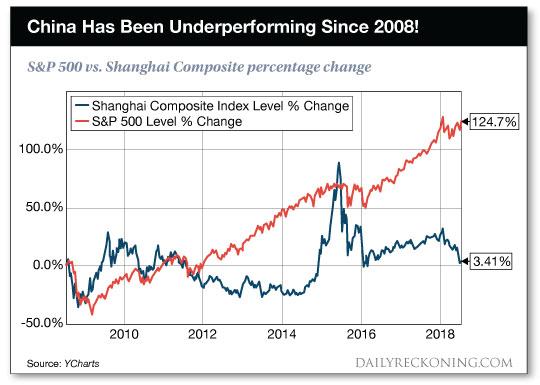
Since the start of 2018, while the S&P 500 is up more than four percent, the Shanghai Composite Index has actually sunk by more than 15 percent, with most of the decline coming in recent weeks as President Trump’s tariffs have been unleashed.

A fifteen percent stock market decline in six months is a major move, even for an emerging nation. If the U.S. market had dropped by 15 percent over the same time period it would be major news.

But there is more to the story of China’s stock market underperformance than just what has happened so far in 2018��

The chart below details the performance of the S&P 500 and the Shanghai Composite over the entire last decade.

ALTTAG

While the U.S. market is up 125 percent, the Chinese market is flat �� up just 3 percent over the last ten years despite an economy that has continued to grow.

With that kind of underperformance (both recent and long-term), you can bet that there are some serious bargains to be had in Chinese stocks.

Two Trade-War-Proof Chinese Stocks Set To Profit

President Trump’s tariffs are focused on goods that get exported to the United States. Those tariffs aren’t going to have any impact on the demand for goods and services that are sold within China.

Yet, Chinese stocks that operate only within China have been sold off along with the overall market, in the face of China’s fast-growing middle class and high consumer demand. That doesn’t make sense, and thus, an opportunity (or two) is born.

Opportunity #1 �� GreenTree Hospitality Group (GHG)

2018 Share Price High �� $25.10

Current Share Price �� $17.36

Trump Trade War Sale Price �� 30 percent off

Based in Shanghai, GreenTree Hospitality was originally founded in 2004 to provide mid-level hotel accommodations in the Shanghai region.

Since its founding, GreenTree has grown rapidly to become the fourth largest network of economy to mid-scale hotels in China. The company’s network boasts 2,354 hotels with 195,552 rooms in 263 different Chinese cities.

GreenTree is a “pure play” hotel franchisor. Almost 99 percent of the hotel network is operated not by GreenTree itself, but by franchisees. I like that business model because it is capital light and able to generate free cash flow. The franchise model also allows for a much higher rate of growth since the company doesn’t have to finance the building of the hotels themselves.

While GreenTree has grown rapidly since inception, there is still a huge opportunity in front of the company. For context on the size of the remaining prize, consider that while the United States has 20 hotels per 1,000 people�� while China has just 4.1

Opportunity #2 �� Yum China Holdings (YUMC)

2018 Share Price High �� $48.75

Current Share Price �� $36.65

Trump Trade War Sale Price �� 25 percent off

Having the rights to the KFC trademark in a country of 1.2 billion people where chicken is the by far the preferred source of protein is a nice position to be in.

That is where Yum China Holdings finds itself with the exclusive right to operate and sub-license not just the KFC brand within China, but also Pizza Hut, Taco Bell and two Chinese concepts (East Dawning and Little Sheep).

With just five restaurants per one million people, I would say that Yum China Holdings is operating within the very definition of an unsaturated market. This is a company with huge continued growth potential.2

From a single location in 1987, Yum China Holdings now operates 8,100 restaurants that are spread across 1,200 cities in China. The corporate plan is to at least triple that current restaurant count in the coming years.

Having operated for decades within China has created a big advantage for the company. Over the past thirty years, Yum China Holdings has created loyalty amongst consumers in China and has integrated its brands into popular culture.

China fast food

Yum has created this loyalty by not forcing American tastes onto the Chinese people, but instead tailoring menus to cater to local preferences.

Perhaps you have been to China and tasted KFC’s popular Crayfish burger? Maybe not.

Either way, Trump’s trade war has knocked nearly a third off the market cap of both of these companies yet hasn’t impacted their future growth prospects one bit. That is an appetizing dish no matter what your cultural tastes may be.

Here’s to looking through the windshield,

Jody Chudley

Jody Chudley
Financial Analyst, The Daily Edge
EdgeFeedback@AgoraFinancial.com

1China’s Hospitality Industry��Rooms for Growth, ATKearney
2About Yum China Page

Thursday, July 12, 2018

Why Square Inc Stock Is Up 86.5% So Far in 2018

What happened

Shares of mobile payment company Square Inc (NYSE:SQ) have jumped 86.5% so far in 2018, according to data provided by S&P Global Market Intelligence, as operating conditions continue to improve. If the company's growth keeps up, the sky is the limit for the stock.�

So what�

The stock really started to perk up after Square reported first-quarter results. Adjusted revenue jumped 51% from a year ago to $307 million, adjusted EBITDA rose 33% to $36 million, and net loss nearly doubled to $24 million. That loss may sound bad, but spending on research and development and sales to grow the business is what's driving it, and that's a good idea right now.�

Square reader on the counter at a bakery.

Image source: Square.

What's encouraging from an investment standpoint is that EBITDA is rising, indicating that money is starting to flow to the bottom line for Square. I also like that big sellers are beginning to use the platform. Management said that 20% of annualized gross payment volume was from sellers with over $500,000 of transactions, up from 16% a year ago. If Square can move beyond food trucks and salons to bigger retailers, it would be great for the sustainability of the business.�

Now what

Since Square isn't profitable, it's tough to call the stock cheap by any traditional metrics today. But the company is growing at a rapid clip and upending the traditional payments business in the process. As Square expands its offerings to include more services -- from scheduling to capital -- I think it could be one of the most disruptive payment processing companies on the market. This is a business with a bright future still ahead.

Wednesday, July 11, 2018

Galaxy Resources Sal De Vida Project Is About To Be De-Risked After A Huge Cash Sale To POSCO

For a background on Galaxy Resources ("Galaxy") investors can read my previous articles:

June 22, 2016 - Galaxy Resources - An Excellent Way To Invest Into The Lithium Miners. August 22, 2016 - Galaxy Resources Is An Outstanding Buy After Its Recent 20% Fall. October 3, 2017 - Will Galaxy Resources Be Next With Some Good News?

Note: Since the above articles Galaxy did a 5:1 share consolidation. Therefore the stock prices quoted in the above articles need to be multiplied by 5x to compare to the current stock price.

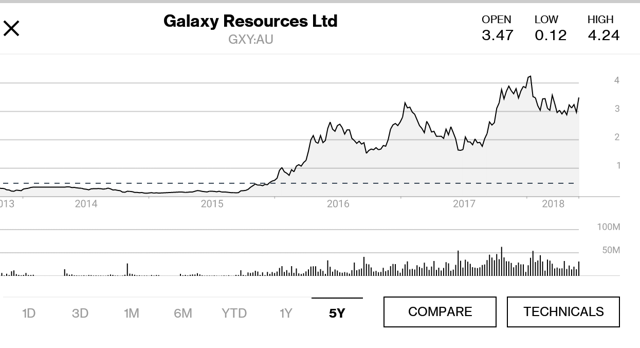
Galaxy Resources [ASX:GXY] (OTCPK:GALXF) - Price = AUD 3.42

Galaxy Resources is an Australian pure play lithium miner with 3 lithium projects globally.

Galaxy Resources 5 year price graph

Source: Bloomberg

Galaxy Resources three lithium projects (all 100% owned) Mt Cattlin Australia (lithium spodumene producer) Sal De Vida Argentina (lithium brine project) James Bay Canada (lithium spodumene project)

Note: From here on I will focus on the Sal De Vida project in Argentina.

The Sal De Vida [SDV] project

Sal De Vida - location map

Source

Galaxy Resources Sal De Vida resources

Prior to the sale to POSCO Galaxy had announced a total Lithium Carbonate Equivalent [LCE] resource at Sal De Vida of 7.23m tonnes contained lithium (at a lithium grade of 780mg/L), or 1.14 million tonnes of contained LCE reserves.

After the sale of the northern tenements to POSCO the total resource estimate falls to 4.09 million tonnes LCE as Galaxy retains the southern tenements. The reserves estimate remains unchanged. See below.

The POSCO deal

On May 29 Galaxy Resources announced, "Galaxy agrees to sell northern tenement package at Sal De Vida for US$280 million to POSCO. Galaxy retains 100% of the tenements in the southern area of Salar del Hombre Muerto in the Catamarca Province included in the recently announced updated feasibility study for the development of Sal de Vida. The southern tenements contain an estimated 4.09million tonnes LCE of JORC compliant measured and indicated resource and 100% of the current 1.14 million tonnes LCE of JORC compliant reserves."

Note: The Sal De Vida salar is part of the Salar del Hombre Muerto.

SDV tenements map - Blue sold to POSCO, and red retained by Galaxy

Source

The key point to note here is that Galaxy Resources retains a large enough section of Sal De Vida (1.14 million tonnes LCE) that they can still produce about 25ktpa LCE over a 40 year mine life, and the Feasibility Study [FS] conclusions (post tax NPV8% of US$1.48 billion) are not impacted at all. Galaxy gets an enormous cash boost that can greatly help fund their SDV development with no need for a project partner.

Infrastructure and access

Access and infrastructure are good as FMC Corp. (FMC) has been producing in the salar since 1997.

Management

Martin Rowley - Independent Non Executive Chairman

Mr Rowley was a co-founder of TSX and LSE-listed First Quantum Minerals Ltd and is currently that company��s Executive Director, Business Development. First Quantum is one of the world's largest copper production companies and the owner of the Ravensthorpe nickel project in Western Australia with a market capitalisation of in excess of A$10 billion. He was previously non-executive Chairman and director of Lithium One Inc., which was acquired by Galaxy by way of a Plan of Arrangement in July 2012. He is also non-executive Chairman and a director of Forsys Metals Corp, a TSX-listed company in the uranium sector.

Anthony Tse - Managing Director

Mr Tse has 20 years of corporate experience in numerous high-growth industries such as technology, internet/mobile, media & entertainment, and resource & commodities �� primarily in senior management, capital markets and M&A roles across Greater China and Asia Pacific in general. His previous management roles include various positions in News Corporation's STAR TV, the Deputy General Manager of TOM Online, Director of Corporate Development at Hutchison Whampoa's TOM Group, President of China Entertainment Television (a joint venture between TOM and Time Warner), and CEO of CSN Corp. He is a Fellow of the Hong Kong Institute of Directors (HKIoD) and a member of the Hong Kong Mining Investment Professionals Association (HKMIPA).

Brian Talbot B.Sc Eng. (Hons) - Chief Operations Officer

Mr Talbot has over 25 years�� experience in mining and minerals processing operations and holds a bachelor��s degree in chemical engineering with Honours. Mr Talbot was previously Galaxy��s General Manager where he has managed the Mt Cattlin mine site increasing production to above plan design. Prior to joining Galaxy he was at Bikita Minerals, a lithium mine in Zimbabwe where he achieved increased product yield and capacity. Mr Talbot has also held the positions of mining company director, general manager and metallurgist at various mine operations in Egypt and South Africa with diverse experience in designing, planning and managing profitable mining operations.

You can read more here.

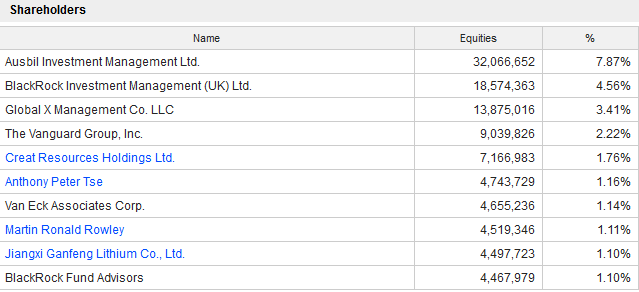
Largest Shareholders

Source

Note: Insider ownership should increase as options are converted to shares if performance targets are met. A strong level of institutional ownership.

Sal De Vida PFS

On May 15, 2018 Galaxy reported: "Sal de Vida - Updated Feasibility Study." Highlights include:

"Results from the updated feasibility study for the Sal de Vida Project validate a technically superior, highly profitable, long life (40 years) and low-cost lithium and potash project. Post-tax Net Present Value ("NPV") of US$1.48 billion at an 8% discount rate (real). Post-tax Internal Rate of Return ("IRR") of 26.9%, with post-tax payback period of approximately 3 years from first production. Capital cost estimate of US$474million, including US$31million for an optional potash production circuit. Operating costs at full production of US$3,144 per tonne of lithium carbonate after potash credits. Average annual revenues of US$360 million and EBITDA of US$270 million. JORC-compliant reserve estimate of 1.1 million tonnes of recoverable lithium carbonate equivalent ("LCE"), supports a long initial project life with 25ktpa of lithium carbonate and 94ktpa of potash production respectively." Valuation

Galaxy Resources has no debt and cash as at 31 December 2017 of AUD 59.7m. Current market cap is AUD 1.39b.

My recently updated price target (assuming the US$ 280m POSCO deal goes through) for end 2021 is AUD 5.90 or ~1.7x higher, based on Mt Catlin (250ktpa spodumene) and Sal de Vida (15ktpa LCE) being in production. Assumes a cost of production of USD 3,144/t LCE for brine (USD 320/t spodumene) and a selling price of USD 12,000/t LCE for brine (USD 900/t spodumene). Assumes a CapEx of USD 474m to get SDV to production.

Note: My model suggests SDV can be fully funded by Galaxy from retained earnings and the POSCO deal monies.

By 2023/2024 my price target increases to AUD 11.83 or ~3.5x higher, based on Mt Catlin (250ktpa spodumene), Sal de Vida (25ktpa LCE), and James Bay (250ktpa spodumene) all being in production. Assumes the same costs and selling prices as above. Galaxy would then be an AUD 4.6b market cap lithium pure play global leader.

Current analyst consensus estimates for Galaxy Resources is AUD 4.15 or 17% upside. I would assume the analysts have not yet factored in the POSCO deal, as the deal has not yet finalized. Once it finalizes I would expect a significant target increase closer to AUD 5.00.

Catalysts Q3, 2018 - POSCO deal due to complete. Q3, 2018 - The FMC lithium IPO should give a boost to Galaxy's SDV project valuation being located nearby. 2018 - Mt Cattlin resource upgrade. James Bay Feasibility Study. 2018/19 - Announcements to commence construction of Sal De Vida. 2020/21 - Sal De Vida production to begin. Competitors For coverage of the lithium miner competitors investors can view my articles "Lithium Miners News For The Month Of May 2018", and "Lithium Junior Miner News For The Month Of May 2018." Risks Lithium prices falling. My model does forecast a possible mild lithium oversupply in 2019/2020 as does Benchmark Minerals recent analysis. The electric vehicle [EV] boom and energy storage boom may not continue. Technology change may replace lithium in the battery. Very unlikely The usual mining risks - Exploration risks, funding risks, permitting risks, production risks. As discussed funding risk at SDV will shortly be gone. Management and currency risks. Sovereign risk is medium in Argentina and low in Australia and Canada. Stock market risks - Dilution, lack of liquidity (best to buy on local exchange), market sentiment.

Investors can view the company presentation here.

Conclusion

Galaxy Resources has had a good run the past 3-4 years. Assuming the recent POSCO deal goes through the stock will re-rate significantly higher. In fact, my modeling shows Galaxy will no longer need any funding whatsoever to develop Sal De Vida, nor will they need a project partner. This is highly significant in several ways. Firstly it de-risks the Sal De Vida project from a funding perspective, and also allows Galaxy to retain 100% ownership should they choose. Secondly the USD 280m of cash massively strengthens Galaxy's already strong balance sheet which de-risks the Company as a whole.

The magic of the POSCO deal for Galaxy and Galaxy shareholders is that the Sal De Vida project economics are not affected, SDV can still have a superb 40 year production life, and the Feasibility Study NPV of USD 1.48b is also completely unchanged. Clearly management at Galaxy has pulled another rabbit from their magical hat.

Given the deal is highly likely to go through investors have just a short window to get onboard before analysts upgrade their targets.

As usual all comments are welcome.

Trend Investing

Thanks for reading the article. If you want to go to the next level, sign up for Trend Investing, my Marketplace service. I share my best investing ideas and latest articles on the latest trends. You will also get access to exclusive CEO interviews and chat room access to me, and to other sophisticated investors. You can benefit from the hundreds of hours of work I've done to analyze the best opportunities in emerging industries, especially the electric vehicle and EV metals sector. You can learn more by reading "The Trend Investing Difference", "Recent Subscriber Feedback On Trend Investing", or sign up here.

My latest related Trend Investing articles are:

An Update On Pilbara Minerals Investing Well - July 2018 An Update On Cobalt Blue

Disclosure: I am/we are long GALAXY RESOURCES [ASX:GXY].

I wrote this article myself, and it expresses my own opinions. I am not receiving compensation for it (other than from Seeking Alpha). I have no business relationship with any company whose stock is mentioned in this article.

Additional disclosure: The information in this article is general in nature and should not be relied upon as personal financial advice.

Editor's Note: This article discusses one or more securities that do not trade on a major U.S. exchange. Please be aware of the risks associated with these stocks.

Tuesday, July 10, 2018

Top 10 Financial Stocks To Buy Right Now

tags:PSB,SLG,OLP,AON,AIG,VLY,CBAN,SFST,NC,STC,

One of last week's biggest winners was�Five Below (NASDAQ:FIVE), which soared 41.3% after posting blowout financial results�and boosting its top- and bottom-line guidance for all of fiscal 2018. At least seven different analysts would go on to jack up their price targets on the stock.

Five Below has been a haven for budget-conscious teens and tweens for years. The fast-growing retailer sells trendy items that -- true to its signage -- are priced at $5 or below. A year ago, the chain's success was widely credited to the booming popularity of fidget spinners, but clearly there's more to this story than one hot fad. Sales keep growing at the store level, which -- paired with brisk expansion -- is resulting in healthy double-digit-percentage revenue growth.

Image source: Five Below.

Rising above

Net sales surged 27% to hit $296.3 million for the fiscal first quarter ending in early May. The buildout of new stores continues to be the primary driver of top-line gains. There are now 658 Five Below stores open, 19% more than what the cheap-chic empire had a year earlier. Comparable-store sales rose 3.2%.�

Top 10 Financial Stocks To Buy Right Now: PS Business Parks Inc.(PSB)

Advisors' Opinion:
  • [By Joseph Griffin]

    PS Business Parks (NYSE: PSB) and Apollo Commercial Real Est. Finance (NYSE:ARI) are both mid-cap finance companies, but which is the superior business? We will compare the two companies based on the strength of their analyst recommendations, valuation, dividends, institutional ownership, profitability, earnings and risk.

Top 10 Financial Stocks To Buy Right Now: SL Green Realty Corporation(SLG)

Advisors' Opinion:
  • [By Max Byerly]

    Get a free copy of the Zacks research report on SL Green Realty (SLG)

    For more information about research offerings from Zacks Investment Research, visit Zacks.com

  • [By Max Byerly]

    Shares of SL Green Realty Corp (NYSE:SLG) have been given an average recommendation of “Hold” by the eighteen ratings firms that are presently covering the stock, Marketbeat Ratings reports. Three analysts have rated the stock with a sell recommendation, six have given a hold recommendation and nine have given a buy recommendation to the company. The average 12-month price objective among analysts that have issued a report on the stock in the last year is $111.54.

  • [By Joseph Griffin]

    Swiss National Bank lessened its stake in SL Green Realty (NYSE:SLG) by 13.9% during the 1st quarter, according to its most recent filing with the Securities and Exchange Commission (SEC). The firm owned 315,900 shares of the real estate investment trust’s stock after selling 51,200 shares during the period. Swiss National Bank owned 0.35% of SL Green Realty worth $30,589,000 as of its most recent SEC filing.

  • [By Max Byerly]

    Sterlingcoin (SLG) is a proof-of-stake (PoS) coin that uses the
    X13 hashing algorithm. It was first traded on September 21st, 2014. Sterlingcoin’s total supply is 4,241,006 coins. Sterlingcoin’s official Twitter account is @SterlingcoinSLG and its Facebook page is accessible here. The Reddit community for Sterlingcoin is /r/sterlingcoin and the currency’s Github account can be viewed here. The official website for Sterlingcoin is sterlingcoin.org.

  • [By Shane Hupp]

    Easterly Government Properties (NYSE: DEA) and SL Green Realty (NYSE:SLG) are both finance companies, but which is the better business? We will contrast the two companies based on the strength of their institutional ownership, analyst recommendations, risk, profitability, dividends, valuation and earnings.

Top 10 Financial Stocks To Buy Right Now: One Liberty Properties Inc.(OLP)

Advisors' Opinion:
  • [By Ethan Ryder]

    Get a free copy of the Zacks research report on One Liberty Properties (OLP)

    For more information about research offerings from Zacks Investment Research, visit Zacks.com

  • [By Joseph Griffin]

    Get a free copy of the Zacks research report on One Liberty Properties (OLP)

    For more information about research offerings from Zacks Investment Research, visit Zacks.com

  • [By Joseph Griffin]

    One Liberty Properties, Inc. (NYSE:OLP) VP Justin Clair sold 3,100 shares of the company’s stock in a transaction dated Monday, May 21st. The stock was sold at an average price of $25.00, for a total value of $77,500.00. Following the completion of the transaction, the vice president now directly owns 32,566 shares in the company, valued at $814,150. The sale was disclosed in a filing with the SEC, which is available through this hyperlink.

Top 10 Financial Stocks To Buy Right Now: Aon Corporation(AON)

Advisors' Opinion:
  • [By Max Byerly]

    State of Wisconsin Investment Board decreased its holdings in shares of Aon (NYSE:AON) by 9.2% in the 1st quarter, Holdings Channel reports. The fund owned 384,127 shares of the financial services provider’s stock after selling 38,942 shares during the quarter. State of Wisconsin Investment Board’s holdings in AON were worth $53,905,000 at the end of the most recent quarter.

  • [By Stephan Byrd]

    US Bancorp DE raised its stake in shares of Aon (NYSE:AON) by 3.0% in the first quarter, according to the company in its most recent disclosure with the SEC. The firm owned 40,448 shares of the financial services provider’s stock after acquiring an additional 1,178 shares during the quarter. US Bancorp DE’s holdings in AON were worth $5,676,000 as of its most recent filing with the SEC.

  • [By Lisa Levin] Companies Reporting Before The Bell Celgene Corporation (NASDAQ: CELG) is projected to report quarterly earnings at $1.96 per share on revenue of $3.46 billion. Aon plc (NYSE: AON) is expected to report quarterly earnings at $2.8 per share on revenue of $2.93 billion. American Axle & Manufacturing Holdings, Inc. (NYSE: AXL) is estimated to report quarterly earnings at $0.81 per share on revenue of $1.75 billion. Alibaba Group Holding Limited (NYSE: BABA) is expected to report quarterly earnings at $0.88 per share on revenue of $9.27 billion. LifePoint Health, Inc. (NASDAQ: LPNT) is projected to report quarterly earnings at $1.13 per share on revenue of $1.62 billion. V.F. Corporation (NYSE: VFC) is estimated to report quarterly earnings at $0.65 per share on revenue of $2.90 billion. Newell Brands Inc. (NYSE: NWL) is expected to report quarterly earnings at $0.26 per share on revenue of $3.05 billion. Titan International, Inc. (NYSE: TWI) is projected to report quarterly earnings at $0.04 per share on revenue of $407.27 million. Boise Cascade Company (NYSE: BCC) is expected to report quarterly earnings at $0.45 per share on revenue of $1.09 billion. Cheniere Energy, Inc. (NYSE: LNG) is estimated to report quarterly earnings at $0.39 per share on revenue of $1.59 billion. Cboe Global Markets, Inc. (NASDAQ: CBOE) is projected to report quarterly earnings at $1.24 per share on revenue of $308.05 million. ITT Inc. (NYSE: ITT) is estimated to report quarterly earnings at $0.73 per share on revenue of $683.96 million. Fred's, Inc. (NASDAQ: FRED) is expected to report quarterly loss at $0.19 per share on revenue of $551.00 million. Virtu Financial, Inc. (NASDAQ: VIRT) is projected to report quarterly earnings at $0.52 per share on revenue of $288.31 million. Cheniere Energy Partners, L.P. (NYSE: CQP) is expected to report quarterly earnings at $0.57 per share on revenue of $1.38 billion. Genesis Energy, L.P
  • [By Logan Wallace]

    CorVel (NASDAQ: CRVL) and AON (NYSE:AON) are both business services companies, but which is the superior stock? We will contrast the two businesses based on the strength of their risk, institutional ownership, dividends, profitability, analyst recommendations, earnings and valuation.

  • [By Joseph Griffin]

    AON (NYSE:AON) had its price target hoisted by Citigroup from $160.00 to $165.00 in a report issued on Tuesday morning. They currently have a buy rating on the financial services provider’s stock.

  • [By Logan Wallace]

    Get a free copy of the Zacks research report on AON (AON)

    For more information about research offerings from Zacks Investment Research, visit Zacks.com

Top 10 Financial Stocks To Buy Right Now: American International Group Inc.(AIG)

Advisors' Opinion:
  • [By Lee Jackson]

    American International Group Inc. (NYSE: AIG) was only a DJIA member for four years when it was removed on September 22, 2008. In an ironical twist, AIG was replaced with Kraft Foods, which only lasted about four years on the index. AIG was removed during the credit and mortgage crisis and was ejected after the government propped up the insurer with stimulus funds. The shares closed most recently at $55.43.

  • [By Logan Wallace]

    Gifford Fong Associates acquired a new position in shares of American International Group (NYSE:AIG) in the first quarter, according to its most recent 13F filing with the SEC. The institutional investor acquired 44,100 shares of the insurance provider’s stock, valued at approximately $2,400,000.

  • [By Max Byerly]

    These are some of the media stories that may have effected Accern’s rankings:

    Get American International Group alerts: AIG’s loss for European business worsens in 2017 (businessinsurance.com) $1.26 EPS Expected for American International Group (AIG) This Quarter (americanbankingnews.com) UBS: Buy AIG After Earnings Estimates ‘Bottom Out’ (finance.yahoo.com) American International Group (AIG) Stock Rating Upgraded by UBS (americanbankingnews.com) American International Group (AIG) Receives Average Recommendation of “Hold” from Analysts (americanbankingnews.com)

    American International Group traded up $0.36, hitting $55.15, during mid-day trading on Friday, MarketBeat.com reports. The stock had a trading volume of 9,821,608 shares, compared to its average volume of 6,828,715. The company has a debt-to-equity ratio of 0.53, a current ratio of 0.27 and a quick ratio of 0.27. American International Group has a 1-year low of $49.57 and a 1-year high of $67.30. The firm has a market cap of $49.51 billion, a P/E ratio of 22.98, a PEG ratio of 1.01 and a beta of 1.24.

  • [By Max Byerly]

    Get a free copy of the Zacks research report on American International Group (AIG)

    For more information about research offerings from Zacks Investment Research, visit Zacks.com

  • [By Stephan Byrd]

    Suntrust Banks Inc. boosted its position in shares of American International Group Inc (NYSE:AIG) by 12.4% in the first quarter, according to the company in its most recent 13F filing with the Securities and Exchange Commission. The institutional investor owned 36,736 shares of the insurance provider’s stock after purchasing an additional 4,048 shares during the period. Suntrust Banks Inc.’s holdings in American International Group were worth $1,998,000 at the end of the most recent reporting period.

  • [By Logan Wallace]

    Sentry Investment Management LLC lessened its holdings in American International Group (NYSE:AIG) by 8.6% during the first quarter, HoldingsChannel reports. The firm owned 64,968 shares of the insurance provider’s stock after selling 6,147 shares during the quarter. Sentry Investment Management LLC’s holdings in American International Group were worth $3,536,000 at the end of the most recent reporting period.

Top 10 Financial Stocks To Buy Right Now: Valley National Bancorp(VLY)

Advisors' Opinion:
  • [By Stephan Byrd]

    Federated Investors Inc. PA lessened its holdings in Valley National Bank (NYSE:VLY) by 12.3% during the first quarter, according to its most recent 13F filing with the Securities and Exchange Commission (SEC). The fund owned 352,694 shares of the financial services provider’s stock after selling 49,476 shares during the period. Federated Investors Inc. PA owned about 0.11% of Valley National Bank worth $4,395,000 at the end of the most recent quarter.

  • [By Ethan Ryder]

    Swiss National Bank lifted its position in Valley National Bank (NYSE:VLY) by 21.0% in the first quarter, according to the company in its most recent disclosure with the Securities and Exchange Commission (SEC). The institutional investor owned 544,300 shares of the financial services provider’s stock after purchasing an additional 94,600 shares during the period. Swiss National Bank owned about 0.16% of Valley National Bank worth $6,782,000 as of its most recent filing with the Securities and Exchange Commission (SEC).

  • [By Joseph Griffin]

    Trustmark (NASDAQ: TRMK) and Valley National Bank (NYSE:VLY) are both mid-cap finance companies, but which is the superior business? We will compare the two companies based on the strength of their analyst recommendations, profitability, institutional ownership, valuation, dividends, risk and earnings.

  • [By Stephan Byrd]

    Valley National Bank (NYSE:VLY) announced a quarterly dividend on Tuesday, May 22nd, RTT News reports. Stockholders of record on Friday, June 15th will be paid a dividend of 0.11 per share by the financial services provider on Tuesday, July 3rd. This represents a $0.44 annualized dividend and a dividend yield of 3.39%.

Top 10 Financial Stocks To Buy Right Now: Colony Bankcorp Inc.(CBAN)

Advisors' Opinion:
  • [By Stephan Byrd]

    Media stories about Colony Bankcorp (NASDAQ:CBAN) have trended somewhat positive this week, according to Accern. The research group identifies positive and negative media coverage by monitoring more than 20 million news and blog sources in real time. Accern ranks coverage of companies on a scale of negative one to one, with scores closest to one being the most favorable. Colony Bankcorp earned a daily sentiment score of 0.02 on Accern’s scale. Accern also gave news stories about the financial services provider an impact score of 48.3992787299045 out of 100, indicating that recent media coverage is somewhat unlikely to have an effect on the company’s share price in the near term.

Top 10 Financial Stocks To Buy Right Now: Southern First Bancshares Inc.(SFST)

Advisors' Opinion:
  • [By Stephan Byrd]

    Get a free copy of the Zacks research report on Southern First Bancshares (SFST)

    For more information about research offerings from Zacks Investment Research, visit Zacks.com

  • [By Shane Hupp]

    DBS Grp HOLDING/S (OTCMKTS: DBSDY) and Southern First Bancshares (NASDAQ:SFST) are both finance companies, but which is the better stock? We will contrast the two businesses based on the strength of their analyst recommendations, earnings, dividends, valuation, risk, profitability and institutional ownership.

Top 10 Financial Stocks To Buy Right Now: New Century Bancorp Inc.(NC)

Advisors' Opinion:
  • [By Stephan Byrd]

    Whirlpool (NYSE: WHR) and NACCO Industries (NYSE:NC) are both consumer discretionary companies, but which is the superior stock? We will contrast the two companies based on the strength of their profitability, valuation, risk, dividends, institutional ownership, analyst recommendations and earnings.

Top 10 Financial Stocks To Buy Right Now: Stewart Information Services Corporation(STC)

Advisors' Opinion:
  • [By Ethan Ryder]

    StarChain (CURRENCY:STC) traded 8.7% lower against the US dollar during the 24-hour period ending at 20:00 PM E.T. on May 14th. StarChain has a market cap of $0.00 and approximately $5.27 million worth of StarChain was traded on exchanges in the last 24 hours. One StarChain token can now be purchased for about $0.0925 or 0.00001062 BTC on major cryptocurrency exchanges. During the last seven days, StarChain has traded down 16.3% against the US dollar.

  • [By Stephan Byrd]

    StarChain (CURRENCY:STC) traded down 2.8% against the dollar during the one day period ending at 21:00 PM Eastern on May 31st. One StarChain token can now be bought for about $0.0729 or 0.00000971 BTC on exchanges. StarChain has a market cap of $0.00 and approximately $2.12 million worth of StarChain was traded on exchanges in the last day. In the last seven days, StarChain has traded down 18.5% against the dollar.

  • [By Logan Wallace]

    StarChain (CURRENCY:STC) traded 13% higher against the U.S. dollar during the one day period ending at 22:00 PM E.T. on June 3rd. StarChain has a total market capitalization of $0.00 and approximately $3.20 million worth of StarChain was traded on exchanges in the last day. One StarChain token can currently be purchased for about $0.0814 or 0.00001057 BTC on major cryptocurrency exchanges. In the last seven days, StarChain has traded 1.2% lower against the U.S. dollar.

Monday, July 9, 2018

Hawkins (HWKN) Upgraded by TheStreet to C-

TheStreet upgraded shares of Hawkins (NASDAQ:HWKN) from a d+ rating to a c- rating in a report published on Monday.

HWKN has been the topic of several other research reports. BidaskClub raised Hawkins from a sell rating to a hold rating in a report on Wednesday, March 28th. ValuEngine downgraded Hawkins from a hold rating to a sell rating in a report on Wednesday, May 2nd.

Get Hawkins alerts:

Hawkins opened at $36.75 on Monday, according to MarketBeat.com. The company has a market cap of $385.95 million, a P/E ratio of 25.60 and a beta of 0.65. Hawkins has a one year low of $30.55 and a one year high of $47.35. The company has a debt-to-equity ratio of 0.45, a quick ratio of 1.24 and a current ratio of 2.23.

In other news, CFO Jeffrey P. Oldenkamp acquired 1,500 shares of Hawkins stock in a transaction on Tuesday, June 5th. The shares were purchased at an average price of $33.15 per share, with a total value of $49,725.00. Following the acquisition, the chief financial officer now owns 6,763 shares in the company, valued at $224,193.45. The transaction was disclosed in a document filed with the SEC, which is available through this link. Also, CEO Patrick H. Hawkins acquired 6,600 shares of Hawkins stock in a transaction on Tuesday, June 5th. The shares were purchased at an average cost of $32.54 per share, for a total transaction of $214,764.00. The disclosure for this purchase can be found here. In the last ninety days, insiders have acquired 23,185 shares of company stock worth $780,698. Company insiders own 3.70% of the company’s stock.

A number of large investors have recently bought and sold shares of HWKN. Wells Fargo & Company MN lifted its holdings in Hawkins by 523.8% during the 1st quarter. Wells Fargo & Company MN now owns 90,940 shares of the specialty chemicals company’s stock worth $3,197,000 after buying an additional 76,362 shares in the last quarter. BlackRock Inc. lifted its holdings in Hawkins by 4.7% during the 4th quarter. BlackRock Inc. now owns 1,285,418 shares of the specialty chemicals company’s stock worth $45,246,000 after buying an additional 58,254 shares in the last quarter. Millennium Management LLC acquired a new position in shares of Hawkins in the 4th quarter valued at $1,433,000. Dimensional Fund Advisors LP lifted its stake in shares of Hawkins by 6.4% in the 1st quarter. Dimensional Fund Advisors LP now owns 535,837 shares of the specialty chemicals company’s stock valued at $18,835,000 after purchasing an additional 32,323 shares during the period. Finally, UBS Group AG lifted its stake in shares of Hawkins by 144.0% in the 1st quarter. UBS Group AG now owns 40,878 shares of the specialty chemicals company’s stock valued at $1,437,000 after purchasing an additional 24,124 shares during the period. 58.01% of the stock is currently owned by hedge funds and other institutional investors.

About Hawkins

Hawkins, Inc blends, manufactures, and distributes chemicals and specialty ingredients primarily in the United States. It operates in three segments: Industrial, Water Treatment, and Health and Nutrition. The Industrial segment provides industrial chemicals, products, and services primarily to the agriculture, chemical processing, electronics, energy, food, pharmaceutical, plating, and power generation industries.

Friday, July 6, 2018

Attunity (ATTU) Cut to “Hold” at Zacks Investment Research

Attunity (NASDAQ:ATTU) was downgraded by Zacks Investment Research from a “strong-buy” rating to a “hold” rating in a note issued to investors on Wednesday.

According to Zacks, “Attunity is the leading provider of service-orientated software and solutions in the Workplace Applications market. Using Attunity’s software, companies can seamlessly and efficiently connect, transfer, join and stream to and from virtually any data source in real-time, and subsequently use that data to rapidly configure and deploy management-focused Workplace Applications. With successful deployments at thousands of organizations worldwide, Attunity has over seveteen years experience of providing enterprise-class software, both directly and indirectly through a number of strategic and OEM agreements with global-class partners such as HP, IBM, Microsoft, Oracle, Business Objects and Cognos. Listed on Nasdaq and with a worldwide headquarters in Boston, USA, Attunity serves its customers via offices in North America, Europe, Middle East, China and Australia, as well as through a network of local partners. “

Get Attunity alerts:

A number of other brokerages have also weighed in on ATTU. TheStreet raised Attunity from a “d+” rating to a “c-” rating in a report on Thursday, April 26th. ValuEngine raised Attunity from a “hold” rating to a “buy” rating in a report on Wednesday, May 2nd. One analyst has rated the stock with a hold rating, three have assigned a buy rating and one has issued a strong buy rating to the stock. The company currently has an average rating of “Buy” and a consensus price target of $12.33.

Shares of Attunity opened at $11.72 on Wednesday, Marketbeat.com reports. Attunity has a 1-year low of $6.25 and a 1-year high of $12.39. The firm has a market cap of $243.39 million, a P/E ratio of -37.81 and a beta of 1.58.

Attunity (NASDAQ:ATTU) last announced its quarterly earnings data on Thursday, May 3rd. The technology company reported $0.07 earnings per share for the quarter, topping the Zacks’ consensus estimate of ($0.04) by $0.11. Attunity had a negative return on equity of 8.39% and a negative net margin of 7.58%. The firm had revenue of $18.23 million for the quarter, compared to analyst estimates of $15.94 million. analysts expect that Attunity will post -0.04 EPS for the current fiscal year.

A number of hedge funds have recently made changes to their positions in the stock. Renaissance Technologies LLC grew its holdings in Attunity by 24.5% in the fourth quarter. Renaissance Technologies LLC now owns 225,700 shares of the technology company’s stock valued at $1,575,000 after purchasing an additional 44,400 shares during the last quarter. 1492 Capital Management LLC acquired a new stake in Attunity in the fourth quarter valued at $628,000. Deutsche Bank AG grew its holdings in Attunity by 100.4% in the fourth quarter. Deutsche Bank AG now owns 70,956 shares of the technology company’s stock valued at $495,000 after purchasing an additional 35,556 shares during the last quarter. Finally, Whetstone Capital Advisors LLC acquired a new stake in Attunity in the first quarter valued at $242,000. 26.68% of the stock is currently owned by hedge funds and other institutional investors.

About Attunity

Attunity Ltd., together with its subsidiaries, develops, markets, sells, and supports data integration and Big Data management software solutions worldwide. It offers Attunity Replicate, a data replication software for delivering, sharing, and ensuring the availability of data for meeting business operations, analytics, and business intelligence needs; Attunity Gold Client, a replication software for data management within SAP environments; and Attunity Visibility, a software for data usage analytics in Big Data environments.

Get a free copy of the Zacks research report on Attunity (ATTU)

For more information about research offerings from Zacks Investment Research, visit Zacks.com

Sunday, June 24, 2018

HealthStream (HSTM) Cut to “Neutral” at Robert W. Baird

Robert W. Baird cut shares of HealthStream (NASDAQ:HSTM) from an outperform rating to a neutral rating in a research note issued to investors on Wednesday morning. Robert W. Baird currently has $24.00 target price on the technology company’s stock.

Several other equities analysts also recently commented on the company. BidaskClub downgraded HealthStream from a buy rating to a hold rating in a research report on Saturday, June 2nd. ValuEngine upgraded HealthStream from a sell rating to a hold rating in a research report on Monday, May 7th. Barrington Research set a $32.00 price objective on HealthStream and gave the stock a buy rating in a research report on Thursday, May 3rd. Zacks Investment Research upgraded HealthStream from a hold rating to a buy rating and set a $28.00 price objective for the company in a research report on Thursday, May 3rd. Finally, Canaccord Genuity restated a hold rating and set a $26.00 price objective on shares of HealthStream in a research report on Wednesday, May 2nd. Seven investment analysts have rated the stock with a hold rating and three have issued a buy rating to the stock. The company presently has a consensus rating of Hold and an average target price of $25.57.

Get HealthStream alerts:

HealthStream stock opened at $27.94 on Wednesday. The stock has a market capitalization of $903.18 million, a price-to-earnings ratio of 90.19, a PEG ratio of 4.92 and a beta of 0.76. HealthStream has a 12 month low of $21.15 and a 12 month high of $31.53.

HealthStream (NASDAQ:HSTM) last posted its earnings results on Monday, April 30th. The technology company reported $0.11 EPS for the quarter, beating the consensus estimate of $0.06 by $0.05. The firm had revenue of $54.90 million during the quarter, compared to the consensus estimate of $55.85 million. HealthStream had a return on equity of 3.48% and a net margin of 13.42%. The business’s quarterly revenue was up 5.6% on a year-over-year basis. During the same period last year, the company earned $0.04 earnings per share. equities research analysts anticipate that HealthStream will post 0.33 EPS for the current fiscal year.

In related news, insider Michael Sousa sold 16,005 shares of the firm’s stock in a transaction that occurred on Thursday, May 3rd. The stock was sold at an average price of $25.09, for a total transaction of $401,565.45. Following the completion of the sale, the insider now owns 13,830 shares of the company’s stock, valued at $346,994.70. The transaction was disclosed in a legal filing with the Securities & Exchange Commission, which is available at the SEC website. Also, CFO Gerard M. Hayden, Jr. sold 14,226 shares of the firm’s stock in a transaction that occurred on Tuesday, May 15th. The stock was sold at an average price of $26.99, for a total value of $383,959.74. Following the sale, the chief financial officer now directly owns 30,290 shares of the company’s stock, valued at approximately $817,527.10. The disclosure for this sale can be found here. Insiders have sold 49,171 shares of company stock valued at $1,279,902 over the last 90 days. 21.10% of the stock is owned by corporate insiders.

A number of hedge funds and other institutional investors have recently added to or reduced their stakes in HSTM. Stevens Capital Management LP acquired a new stake in HealthStream during the first quarter worth approximately $203,000. Victory Capital Management Inc. acquired a new stake in HealthStream during the first quarter worth approximately $210,000. Teacher Retirement System of Texas acquired a new stake in HealthStream during the fourth quarter worth approximately $215,000. Barclays PLC grew its stake in HealthStream by 45.6% during the first quarter. Barclays PLC now owns 9,444 shares of the technology company’s stock worth $235,000 after purchasing an additional 2,958 shares during the period. Finally, Campbell & CO Investment Adviser LLC acquired a new stake in HealthStream during the first quarter worth approximately $241,000. 71.14% of the stock is owned by institutional investors and hedge funds.

HealthStream Company Profile

HealthStream, Inc provides workforce and provider solutions to the healthcare organizations in the United States. It operates in HealthStream Workforce Solutions and HealthStream Provider Solutions segments. The company offers workforce development solutions comprising software-as-a-service (SaaS) and subscription-based products to meet talent management, training, certification, competency assessment, performance appraisal, and development needs, as well as training, implementation, and account management services.

Analyst Recommendations for HealthStream (NASDAQ:HSTM)

Monday, June 18, 2018

Don't even think about investing without a diversification strategy: Advisor

Properly investing requires taking the time to create an investment strategy so that you have a plan that allows you to stick with it when things get tough. Investing without an established plan increases your risk. Following an investment strategy is something that everyone should be doing to ensure that they are getting the most out of their investments.

There are two basic approaches that you can use to build an investment strategy: active investing and passive investing.

Active investing

Most advisors and investors follow what I call an "active" management style. This is an approach that is based on some type of information that the advisor, or investor, thinks gives them an edge in selecting their investment holdings. They might employ some type of fundamental analysis that is based on corporate earnings, growth projections, economic conditions, etc. Or they may use a form of technical analysis, making decisions based on the price movements of an investment. Technical analysis usually involves some form of charting.

More from Straight Talk:
Smartphones are not a financial be-all, end-all
Why robo-advisors will never replace human professionals
How money can, in fact, buy you happiness

Our experience and, indeed, academic evidence show that no one, even the best active managers, can consistently predict what is going to happen in the markets �� even with all the fancy tools that are available today. For our clients, and for our own investment portfolios, we follow a different approach.

Passive investing

We follow what is often referred to as a "passive" investment strategy. That simply means that we don't try to forecast which investments are going to do well and which ones are not. So we own them all. We build our portfolios using a globally diversified mix of low-cost funds based on our clients' risk tolerances and needs �� a strategy known as strategic asset allocation. That means that we own a mix of stocks and bonds that give us broad exposure to many asset classes (such as U.S. equity and real estate).

Broadly speaking, our portfolios are built with stocks and bonds. Then we go a little deeper.

The stock side of our portfolio is made up of:

U.S. stocks: From the largest publicly traded U.S. companies to the smallest, not just the Dow 30 or the S&P 500, we own them all. International developed: Large and small companies from across the developed world, giving us exposure to Europe, Australia and the Far East. International emerging: Large and small companies from the emerging markets around the world. This category gives us exposure to less-developed countries, such as the Philippines, Brazil, Mexico and South Africa. It is important to note that this asset class is very volatile, so we limit our exposure to it. Real estate: These are companies that get their income from rental properties �� office-building companies, hotels, storage facilities and retail developers are examples.

The bond side of our portfolio is also diversified. It consists of:

Short-term, high-quality: Government and high-quality corporate bonds maturing in three years or less, not just from the U.S. Intermediate-term, high-quality: Similar to our short-term exposure, but these bonds mature in three to 10 years. Treasury inflation-protected securities (TIPS): Basically U.S. government bonds with an inflation rider. The purpose of diversifying your portfolio

The main purpose of diversifying your portfolio is to reduce the overall risk. We are trying to diversify away as much of the risk that is inherent in investing that we can. It's the proverbial "Don't put all of your eggs in one basket" strategy. We are spreading our investment dollars across asset classes that are non-correlated. We own stocks because they behave differently than bonds, and international stocks because they behave differently than U.S. companies.

Where the riskiest portfolio possible would be holding one stock or one bond, we spread the risk across thousands of different securities. It's important to note that a well-diversified portfolio will not experience all the gains when the market is rising, but it also won't suffer the extreme losses when things go the other way.

Sign Up for Our Newsletter Your Wealth Weekly advice on managing your money SIGN UP NOW Get this delivered to your inbox, and more info about about our products and services.
By signing up for newsletters, you are agreeing to our Terms of Use and Privacy Policy. .investigation-wrapper .description{ text-align:center; padding-bottom:15px; } .nl-privacy{ font-size: 10px; padding-top: 20px; display:block; } .wildcard .investigation-wrapper { -webkit-box-shadow: 0px 0px 4px 0px #999999; /* Android 2.3+, iOS 4.0.2-4.2, Safari 3-4 */ box-shadow: 5px 5px 5px 0px #999989; } .subsection .investigation{ background: #efefef; border-radius: 3px; padding: 10px 20px 20px 20px; } .investigation small{white-space:normal;} .subsection .investigation h1{ text-transform: uppercase; text-align: center; font-family: "Gotham Narrow Ssm 5r"; margin-bottom: 0px; padding-bottom:0px; font-size: 18px; margin-top: 10px; word-spacing: 1.5px; color: #333333; } .subsection .investigation .headline_title { font-size: 28px; padding-top: 20px; display: block; font-family: "Gotham Narrow Ssm 7r"; padding-bottom:5px; } .subsection .email-info { background: rgba(74, 144, 226, 1); max-width: 140px; margin: 0px auto; text-align: center; padding: 6px 1px; color: #fff; border-radius: 5px; } .subsection .email-info { color:#fff; } .subsection .email-info:hover{ background: #2077B6; } body .subsection.investigation-wrapper{overflow:visible;}

Your specific allocation should be based on several factors. You will want to consider your cash needs, time horizon, risk tolerance, risk capacity and need for risk. Someone with an aggressive portfolio will generally own more stocks than bonds. More conservative portfolios will lean more toward bonds.

Investing requires time and attention

It's important to remember that building an investment portfolio is not a set-it-and-forget-it process. Once you are invested, you need to make sure that the portfolio stays in balance. As asset classes move in and out of favor, you want to make sure that your mix stays true. For example, an investor who had a 60/40 stock-to-bond mix at the beginning of 2017 may have finished the year at 70/30 because of the big rally in stock prices. If not rebalanced, the portfolio would be taking on more risk. A disciplined rebalance strategy will bring the mix back to 60/40 by selling some of the stocks while their price is up and buying some of the bonds while their price is lower. Buying low and selling high is how the investment game is supposed to be played.

We know that we cannot control or predict the markets, so we don't try. Instead, we work on controlling what we can control. We can control the risk in the portfolio by the asset allocation mix. We work to control the costs of investing by using low-cost vehicles and limiting trading. We also try to control the tax consequences by managing gains and losses as much as possible.

(Editor's Note: This column originally appeared on Investopedia.com.)

�� By Bob Rall, principal at Rall Capital Management

Friday, June 1, 2018

Weekly Research Analysts’ Ratings Updates for AutoZone (AZO)

AutoZone (NYSE: AZO) recently received a number of ratings updates from brokerages and research firms:

5/24/2018 – AutoZone was upgraded by analysts at ValuEngine from a “sell” rating to a “hold” rating. 5/23/2018 – AutoZone had its price target lowered by analysts at JPMorgan Chase & Co. from $900.00 to $800.00. They now have an “overweight” rating on the stock. 5/23/2018 – AutoZone had its price target lowered by analysts at Wedbush from $750.00 to $680.00. They now have an “outperform” rating on the stock. 5/23/2018 – AutoZone had its price target lowered by analysts at Royal Bank of Canada to $668.00. They now have a “market perform” rating on the stock. 5/23/2018 – AutoZone had its price target lowered by analysts at Morgan Stanley from $750.00 to $700.00. They now have an “equal weight” rating on the stock. 5/22/2018 – AutoZone had its “buy” rating reaffirmed by analysts at Wells Fargo & Co. They now have a $700.00 price target on the stock. 5/7/2018 – AutoZone was upgraded by analysts at Goldman Sachs Group Inc from a “buy” rating to a “conviction-buy” rating. They now have a $491.13 price target on the stock. 5/2/2018 – AutoZone was downgraded by analysts at ValuEngine from a “hold” rating to a “sell” rating. 4/25/2018 – AutoZone had its “buy” rating reaffirmed by analysts at Argus. They now have a $850.00 price target on the stock, down previously from $875.00. 4/23/2018 – AutoZone is now covered by analysts at Wells Fargo & Co. They set an “outperform” rating and a $700.00 price target on the stock. 4/17/2018 – AutoZone had its “neutral” rating reaffirmed by analysts at Guggenheim. 4/5/2018 – AutoZone was upgraded by analysts at Wedbush from a “neutral” rating to an “outperform” rating. They now have a $750.00 price target on the stock, up previously from $670.00.

AutoZone stock opened at $653.78 on Thursday. The company has a debt-to-equity ratio of -3.79, a quick ratio of 0.15 and a current ratio of 0.98. AutoZone, Inc. has a 12-month low of $491.13 and a 12-month high of $797.89. The firm has a market cap of $17.15 billion, a P/E ratio of 15.19, a P/E/G ratio of 0.88 and a beta of 0.85.

Get AutoZone Inc alerts:

AutoZone (NYSE:AZO) last released its earnings results on Tuesday, May 22nd. The company reported $13.42 earnings per share (EPS) for the quarter, beating the Zacks’ consensus estimate of $12.99 by $0.43. AutoZone had a net margin of 12.00% and a negative return on equity of 88.86%. The company had revenue of $2.26 billion for the quarter, compared to the consensus estimate of $2.71 billion. During the same quarter in the previous year, the company earned $11.44 EPS. AutoZone’s quarterly revenue was down 13.7% compared to the same quarter last year. equities research analysts expect that AutoZone, Inc. will post 49.85 EPS for the current fiscal year.

In related news, Director Douglas H. Brooks bought 162 shares of the company’s stock in a transaction that occurred on Monday, April 16th. The shares were bought at an average price of $607.49 per share, for a total transaction of $98,413.38. Following the transaction, the director now directly owns 1,904 shares of the company’s stock, valued at $1,156,660.96. The transaction was disclosed in a filing with the Securities & Exchange Commission, which can be accessed through this hyperlink. 2.60% of the stock is owned by insiders.

Institutional investors have recently added to or reduced their stakes in the stock. Synovus Financial Corp bought a new stake in AutoZone during the 1st quarter valued at $135,000. First Republic Investment Management Inc. bought a new stake in AutoZone during the 4th quarter valued at $202,000. John G Ullman & Associates Inc. bought a new stake in AutoZone during the 4th quarter valued at $213,000. Truepoint Inc. bought a new stake in AutoZone during the 4th quarter valued at $213,000. Finally, Chilton Capital Management LLC bought a new stake in AutoZone during the 4th quarter valued at $213,000. Institutional investors own 88.96% of the company’s stock.

AutoZone, Inc retails and distributes automotive replacement parts and accessories. It offers various products for cars, sport utility vehicles, vans, and light trucks, including new and remanufactured automotive hard parts, maintenance items, accessories, and non-automotive products. The company's products include A/C compressors, batteries and accessories, bearings, belts and hoses, calipers, carburetors, chassis, clutches, CV axles, engines, fuel pumps, fuses, ignition and lighting products, mufflers, radiators, thermostats, starters and alternators, and water pumps.

Wednesday, May 30, 2018

Top Insurance Stocks To Buy For 2018

tags:AON,PRU,AIG,PFG,

This recession call is coming from inside the house.

The Bank of Canada has highlighted elevated household debt and imbalances within the nation’s real estate market as the two chief vulnerabilities to the financial system in the event of a recession.

But what could trigger such a downturn? Macquarie Capital Markets offers one simple answer: the housing market itself -- highlighting that the share of employment tied to construction as well as finance, insurance and real estate is nearly two standard deviations above its long-term average.

#lazy-img-328065795:before{padding-top:56.25%;}

Tighter mortgage rules and higher interest rates have weighed on activity in formerly high-flying Canadian housing markets, with home sales in Toronto having their worst start to the year since 2009.

Top Insurance Stocks To Buy For 2018: Aon Corporation(AON)

Advisors' Opinion:
  • [By Stephan Byrd]

    US Bancorp DE raised its stake in shares of Aon (NYSE:AON) by 3.0% in the first quarter, according to the company in its most recent disclosure with the SEC. The firm owned 40,448 shares of the financial services provider’s stock after acquiring an additional 1,178 shares during the quarter. US Bancorp DE’s holdings in AON were worth $5,676,000 as of its most recent filing with the SEC.

  • [By Joseph Griffin]

    AON (NYSE:AON) had its price target hoisted by Citigroup from $160.00 to $165.00 in a report issued on Tuesday morning. They currently have a buy rating on the financial services provider’s stock.

  • [By Max Byerly]

    State of Wisconsin Investment Board decreased its holdings in shares of Aon (NYSE:AON) by 9.2% in the 1st quarter, Holdings Channel reports. The fund owned 384,127 shares of the financial services provider’s stock after selling 38,942 shares during the quarter. State of Wisconsin Investment Board’s holdings in AON were worth $53,905,000 at the end of the most recent quarter.

  • [By Lisa Levin] Companies Reporting Before The Bell Celgene Corporation (NASDAQ: CELG) is projected to report quarterly earnings at $1.96 per share on revenue of $3.46 billion. Aon plc (NYSE: AON) is expected to report quarterly earnings at $2.8 per share on revenue of $2.93 billion. American Axle & Manufacturing Holdings, Inc. (NYSE: AXL) is estimated to report quarterly earnings at $0.81 per share on revenue of $1.75 billion. Alibaba Group Holding Limited (NYSE: BABA) is expected to report quarterly earnings at $0.88 per share on revenue of $9.27 billion. LifePoint Health, Inc. (NASDAQ: LPNT) is projected to report quarterly earnings at $1.13 per share on revenue of $1.62 billion. V.F. Corporation (NYSE: VFC) is estimated to report quarterly earnings at $0.65 per share on revenue of $2.90 billion. Newell Brands Inc. (NYSE: NWL) is expected to report quarterly earnings at $0.26 per share on revenue of $3.05 billion. Titan International, Inc. (NYSE: TWI) is projected to report quarterly earnings at $0.04 per share on revenue of $407.27 million. Boise Cascade Company (NYSE: BCC) is expected to report quarterly earnings at $0.45 per share on revenue of $1.09 billion. Cheniere Energy, Inc. (NYSE: LNG) is estimated to report quarterly earnings at $0.39 per share on revenue of $1.59 billion. Cboe Global Markets, Inc. (NASDAQ: CBOE) is projected to report quarterly earnings at $1.24 per share on revenue of $308.05 million. ITT Inc. (NYSE: ITT) is estimated to report quarterly earnings at $0.73 per share on revenue of $683.96 million. Fred's, Inc. (NASDAQ: FRED) is expected to report quarterly loss at $0.19 per share on revenue of $551.00 million. Virtu Financial, Inc. (NASDAQ: VIRT) is projected to report quarterly earnings at $0.52 per share on revenue of $288.31 million. Cheniere Energy Partners, L.P. (NYSE: CQP) is expected to report quarterly earnings at $0.57 per share on revenue of $1.38 billion. Genesis Energy, L.P

Top Insurance Stocks To Buy For 2018: Prudential Financial Inc.(PRU)

Advisors' Opinion:
  • [By Max Byerly]

    Flippin Bruce & Porter Inc. grew its holdings in shares of Prudential Financial (NYSE:PRU) by 2.3% in the 1st quarter, according to its most recent disclosure with the Securities and Exchange Commission (SEC). The institutional investor owned 61,363 shares of the financial services provider’s stock after acquiring an additional 1,391 shares during the period. Flippin Bruce & Porter Inc.’s holdings in Prudential Financial were worth $6,354,000 as of its most recent SEC filing.

  • [By Zacks]

    Well, given the growing demand for securitized mortgage deals, Barclays plans to package and sell these Irish loans over the next two months. The group of investors that has shown interest in buying residential mortgage backed securities includes M&G Investments, the investment management division of British insurer Prudential Plc (NYSE: PRU) and Pacific Investment Management Co. ("PIMCO").

  • [By Jason Hall, Chuck Saletta, and Reuben Gregg Brewer]

    But that doesn't mean you need to make risky bets to capture solid returns, either, and buying solid companies at reasonable prices can help create a margin of safety and improve your returns, while also decreasing your risk of permanent losses. Three stocks that meet these criteria are small healthcare real-estate specialist�Caretrust REIT Inc�(NASDAQ:CTRE), financial services giant�Prudential Financial Inc�(NYSE:PRU), and energy behemoth�ExxonMobil Corporation�(NYSE:XOM).�

  • [By Joseph Griffin]

    These are some of the headlines that may have effected Accern Sentiment Analysis’s analysis:

    Get Prudential Financial alerts: Prudential (PUK) Presents At 2018 Deutsche Bank Annual Global Financial Services Conference – Slideshow (seekingalpha.com) Leston Welsh joins Prudential Group Insurance as head of Disability and Absence Management (finance.yahoo.com) Contrasting Prudential Financial (PRU) & Old Mutual (ODMTY) (americanbankingnews.com) Prudential again accused with unauthorised money deduction (vir.com.vn) An Application for the Trademark ��MULLINTBG�� Has Been Filed by Prudential Insurance Company (insurancenewsnet.com)

    Prudential Financial traded down $5.05, hitting $94.97, during midday trading on Tuesday, MarketBeat Ratings reports. 2,919,216 shares of the company’s stock were exchanged, compared to its average volume of 2,144,103. The company has a current ratio of 0.12, a quick ratio of 0.12 and a debt-to-equity ratio of 0.35. The firm has a market cap of $42.01 billion, a PE ratio of 8.98, a P/E/G ratio of 0.97 and a beta of 1.52. Prudential Financial has a one year low of $94.51 and a one year high of $127.14.

  • [By Chuck Saletta]

    Prudential Financial (NYSE:PRU) takes such pride in its rock-solid financial condition that it uses an actual rock -- the Rock of Gibraltar�-- as its corporate symbol. Prudential Financial backs up that claim with a balance sheet that has more cash, cash equivalents, and short-term investments�than total debt on it. It also claims a debt-to-equity ratio around 0.6 and a current ratio around 1.0�, which are further signs of a solid financial condition.

Top Insurance Stocks To Buy For 2018: American International Group Inc.(AIG)

Advisors' Opinion:
  • [By Max Byerly]

    These are some of the media stories that may have effected Accern’s rankings:

    Get American International Group alerts: AIG’s loss for European business worsens in 2017 (businessinsurance.com) $1.26 EPS Expected for American International Group (AIG) This Quarter (americanbankingnews.com) UBS: Buy AIG After Earnings Estimates ‘Bottom Out’ (finance.yahoo.com) American International Group (AIG) Stock Rating Upgraded by UBS (americanbankingnews.com) American International Group (AIG) Receives Average Recommendation of “Hold” from Analysts (americanbankingnews.com)

    American International Group traded up $0.36, hitting $55.15, during mid-day trading on Friday, MarketBeat.com reports. The stock had a trading volume of 9,821,608 shares, compared to its average volume of 6,828,715. The company has a debt-to-equity ratio of 0.53, a current ratio of 0.27 and a quick ratio of 0.27. American International Group has a 1-year low of $49.57 and a 1-year high of $67.30. The firm has a market cap of $49.51 billion, a P/E ratio of 22.98, a PEG ratio of 1.01 and a beta of 1.24.

  • [By ]

    Insurance company American International Group Inc. (AIG) stock fell 5.3% as harsh winter weather weighed on profits. But the company's long-term care exposure is relatively minimal.

  • [By Logan Wallace]

    Sentry Investment Management LLC lessened its holdings in American International Group (NYSE:AIG) by 8.6% during the first quarter, HoldingsChannel reports. The firm owned 64,968 shares of the insurance provider’s stock after selling 6,147 shares during the quarter. Sentry Investment Management LLC’s holdings in American International Group were worth $3,536,000 at the end of the most recent reporting period.

Top Insurance Stocks To Buy For 2018: Principal Financial Group Inc(PFG)

Advisors' Opinion:
  • [By WWW.GURUFOCUS.COM]

    For the details of Stilwell Value LLC's stock buys and sells, go to http://www.gurufocus.com/StockBuy.php?GuruName=Stilwell+Value+LLC

    These are the top 5 holdings of Stilwell Value LLCOFG Bancorp (OFG) - 1,614,868 shares, 14.1% of the total portfolio. Kingsway Financial Services Inc (KFS) - 3,780,889 shares, 12.63% of the total portfolio. HopFed Bancorp Inc (HFBC) - 627,128 shares, 7.62% of the total portfolio. Alcentra Capital Corp (ABDC) - 1,251,324 shares, 7.27% of the total portfolio. Shares added by 20.66%Sound Financial Bancorp Inc (SFBC) - 228,600 shares, 7.02% of th
  • [By Joseph Griffin]

    KBC Group NV lowered its position in shares of Principal Financial Group Inc (NYSE:PFG) by 41.4% in the 1st quarter, according to its most recent disclosure with the SEC. The fund owned 201,808 shares of the financial services provider’s stock after selling 142,313 shares during the period. KBC Group NV’s holdings in Principal Financial Group were worth $12,292,000 as of its most recent filing with the SEC.

  • [By Max Byerly]

    Shore Capital reissued their hold rating on shares of Provident Financial (LON:PFG) in a report issued on Thursday.

    PFG has been the subject of several other reports. Liberum Capital reissued a sell rating and set a GBX 483 ($6.48) price objective on shares of Provident Financial in a research note on Monday, February 26th. Peel Hunt reissued a hold rating and set a GBX 870 ($11.67) price objective on shares of Provident Financial in a research note on Tuesday, February 27th. JPMorgan Chase & Co. reduced their price objective on Provident Financial from GBX 1,100 ($14.76) to GBX 750 ($10.06) and set a neutral rating for the company in a research note on Thursday, May 10th. Barclays reissued an underweight rating and set a GBX 584 ($7.84) price objective on shares of Provident Financial in a research note on Wednesday, January 31st. Finally, Societe Generale lowered Provident Financial to a hold rating and set a GBX 1,050 ($14.09) price objective for the company. in a research note on Wednesday, February 28th. Two investment analysts have rated the stock with a sell rating, eleven have assigned a hold rating and two have assigned a buy rating to the company’s stock. Provident Financial presently has a consensus rating of Hold and a consensus price target of GBX 1,190.14 ($15.97).

  • [By Shane Hupp]

    These are some of the news articles that may have impacted Accern’s scoring:

    Get Principal Financial Group alerts: Principal Financial Group (PFG) Approves New $300M Buyback (streetinsider.com) Principal Financial Group (PFG) Announces Share Repurchase Plan (americanbankingnews.com) Is Principal Large Cap Growth I Institutional (PLGIX) a Strong Mutual Fund Pick Right Now? (finance.yahoo.com) Principal Financial Group is Oversold (nasdaq.com) Principal Names New Chief Human Resources Officer (finance.yahoo.com)

    Several equities analysts have recently commented on PFG shares. Morgan Stanley decreased their target price on Principal Financial Group from $79.00 to $77.00 and set an “equal weight” rating on the stock in a research report on Thursday, April 5th. Wells Fargo reaffirmed a “market perform” rating and issued a $76.00 target price on shares of Principal Financial Group in a research report on Monday, January 8th. Credit Suisse Group started coverage on Principal Financial Group in a research report on Wednesday, April 25th. They issued a “neutral” rating and a $62.00 target price on the stock. Bank of America started coverage on Principal Financial Group in a research report on Monday, March 26th. They issued a “neutral” rating and a $65.00 target price on the stock. Finally, UBS started coverage on Principal Financial Group in a research report on Friday, March 2nd. They issued a “neutral” rating and a $69.00 target price on the stock. Two research analysts have rated the stock with a sell rating, seven have given a hold rating and three have issued a buy rating to the company. Principal Financial Group currently has an average rating of “Hold” and an average price target of $71.18.