Friday, March 29, 2019

3 Powerful Ways to Boost 401(k) Savings

&l;p&g;It&s;s funny how beautiful math is when it comes to retirement savings, but it&s;s often counterintutive.

Less is more in the savings realm: Lower fees mean more savings if all other things are equal. You could easily shop for bargain-basement fees in your individual retirement account (IRA) or small-company plan. There&s;s plenty of competition and it&s;s not hard to save.

Here are three powerful -- and easy -- ways to save, according to &l;a href=&q;https://www.forusall.com/401k-blog/low-401k-fees/&q; target=&q;_blank&q;&g;forusall.com&l;/a&g;:

&l;img class=&q;dam-image getty size-large wp-image-1134516576&q; src=&q;https://specials-images.forbesimg.com/dam/imageserve/1134516576/960x0.jpg?fit=scale&q; data-height=&q;640&q; data-width=&q;960&q;&g; Getty

&l;strong&g;1) Invest in Low-Cost Index Funds.&l;/strong&g; They are passively managed, meaning they are not trading and generating big fees. Every retirement plan should offer them as staples. Actively managed funds, in contrast, typically charge more, but deliver lower returns than index funds.

&q;Actively managed funds involve humans doing actual work and analysis, which means they cost more. In fact, a 2016 study by S&a;amp;P Dow Jones Indices found that 90% of active fund managers failed to beat their index targets over the previous 1, 5, and 10-year periods. As it turns out, the higher fees were a significant factor in this underperformance.&q;

&l;strong&g;2) Avoid 12b-1 Fees. &l;/strong&g; These are expenses that fund managers charge you for marketing their funds. I&s;ve always seen them as a pox on returns. They do nothing for you. See if your funds charge them. Avoid them if they do.

&q;The 12b-1 fee might not seem exorbitant, particularly for the services of a good fund adviser, but even a small unnecessary fee can do damage to your overall savings (remember the impact that even a 0.5% increase in fees can have).

It&s;s also worth noting that if your adviser is compensated with 12b-1 fees, they&a;rsquo;re incentivized to build a high-fee fund lineup, often with lots of actively managed funds - something that could be really eating into your plan participants&a;rsquo; retirement nest eggs.&q;

&l;strong&g;3) Benchmark Your Fees. &l;/strong&g; Most savers are loath to to this because it involves homework. But you can save a fortune by seeing which funds are the cheapest to own.

How do you know if you&s;re paying too much? You won&s;t know until you comparison shop by benchmarking. &l;a href=&q;http://mutualfunds.com/index-funds/do-mutual-fund-benchmarks-matter/&q; target=&q;_blank&q;&g;Here&s;s &l;/a&g;a good place to start.

In your 401(k) or 403(b), though, getting fees down is a matter of working with your plan administrator. Since they control the plan, they have to find vendors with rock-bottom rates.&l;/p&g;

Tuesday, March 26, 2019

Top Blue Chip Stocks To Buy For 2019

tags:HCN,MOS,KINS,LGCY,DLTH,

Russ Kaplan is a money manager and newsletter advisor who focuses on buying value-oriented stocks with a multi-year investment horizon; here’s his top idea for conservative investors over the coming year.

One of the most under appreciated stocks on Wall Street is Apple (APPL). The stock is among the bluest of blue chips.

Apple has a financial rating of A++. On every measure we see -- such as price/earning ratio -- Apple is undervalued.

With the death of its founder, investors were skeptical about new leadership, but Tim Cook has done an excellent job. He owns over one million shares of the stock.

Apple is constantly developing new products such as the Apple watch and this is not done as a short-term item being rushed onto the market.

Rather, the company takes a long-term perspective and views its product introductions as something that will constantly be improved over the years.

Top Blue Chip Stocks To Buy For 2019: Welltower Inc.(HCN)

Advisors' Opinion:
  • [By Shane Hupp]

    Welltower Inc (NYSE:HCN), an S&P 500 company headquartered in Toledo, Ohio, is driving the transformation of health care infrastructure. The company invests with leading seniors housing operators, post-acute providers and health systems to fund the real estate infrastructure needed to scale innovative care delivery models and improve people's wellness and overall health care experience.

  • [By Ethan Ryder]

    Welltower Inc (NYSE:HCN), an S&P 500 company headquartered in Toledo, Ohio, is driving the transformation of health care infrastructure. The company invests with leading seniors housing operators, post-acute providers and health systems to fund the real estate infrastructure needed to scale innovative care delivery models and improve people's wellness and overall health care experience.

Top Blue Chip Stocks To Buy For 2019: Mosaic Company (MOS)

Advisors' Opinion:
  • [By Ethan Ryder]

    Bank of Hawaii trimmed its position in shares of Mosaic Co (NYSE:MOS) by 7.1% during the 2nd quarter, according to the company in its most recent filing with the SEC. The institutional investor owned 34,657 shares of the basic materials company’s stock after selling 2,636 shares during the period. Bank of Hawaii’s holdings in Mosaic were worth $972,000 at the end of the most recent reporting period.

  • [By Logan Wallace]

    Luminus Management LLC grew its position in shares of Mosaic Co (NYSE:MOS) by 13.5% during the second quarter, Holdings Channel reports. The fund owned 96,400 shares of the basic materials company’s stock after purchasing an additional 11,429 shares during the quarter. Luminus Management LLC’s holdings in Mosaic were worth $2,704,000 as of its most recent SEC filing.

  • [By Stephan Byrd]

    A number of equities research analysts recently weighed in on MOS shares. Zacks Investment Research raised Mosaic from a “hold” rating to a “buy” rating and set a $32.00 price objective on the stock in a research report on Monday, January 7th. TheStreet raised Mosaic from a “c+” rating to a “b-” rating in a research report on Monday, November 19th. ValuEngine upgraded Mosaic from a “hold” rating to a “buy” rating in a research note on Wednesday, January 2nd. Cowen increased their price target on Mosaic from $38.00 to $43.00 and gave the company an “outperform” rating in a research note on Thursday, November 15th. Finally, Credit Suisse Group reiterated a “hold” rating and issued a $30.00 price target on shares of Mosaic in a research note on Monday, February 4th. Nine analysts have rated the stock with a hold rating, seven have given a buy rating and one has assigned a strong buy rating to the company. The stock currently has an average rating of “Buy” and an average price target of $37.14.

    TRADEMARK VIOLATION WARNING: “Private Advisor Group LLC Sells 4,759 Shares of Mosaic Co (MOS)” was first published by Ticker Report and is the sole property of of Ticker Report. If you are viewing this article on another website, it was illegally copied and reposted in violation of US & international copyright and trademark law. The original version of this article can be accessed at https://www.tickerreport.com/banking-finance/4203142/private-advisor-group-llc-sells-4759-shares-of-mosaic-co-mos.html.

    About Mosaic

  • [By Logan Wallace]

    PNC Financial Services Group Inc. lessened its holdings in shares of Mosaic Co (NYSE:MOS) by 9.0% during the second quarter, according to the company in its most recent Form 13F filing with the Securities and Exchange Commission. The fund owned 31,345 shares of the basic materials company’s stock after selling 3,093 shares during the period. PNC Financial Services Group Inc.’s holdings in Mosaic were worth $879,000 as of its most recent filing with the Securities and Exchange Commission.

Top Blue Chip Stocks To Buy For 2019: Kingstone Companies, Inc(KINS)

Advisors' Opinion:
  • [By Stephan Byrd]

    Kingstone Companies (NASDAQ:KINS) was upgraded by analysts at ValuEngine from a hold rating to a buy rating.

    Kosmos Energy (NYSE:KOS) was upgraded by analysts at ValuEngine from a hold rating to a buy rating.

  • [By Joseph Griffin]

    AXIS Capital (NYSE: AXS) and Kingstone Companies (NASDAQ:KINS) are both finance companies, but which is the better business? We will compare the two businesses based on the strength of their valuation, risk, analyst recommendations, earnings, dividends, institutional ownership and profitability.

  • [By Joseph Griffin]

    Get a free copy of the Zacks research report on Kingstone Companies (KINS)

    For more information about research offerings from Zacks Investment Research, visit Zacks.com

  • [By Shane Hupp]

    RLI (NASDAQ: KINS) and Kingstone Companies (NASDAQ:KINS) are both finance companies, but which is the superior stock? We will contrast the two companies based on the strength of their risk, earnings, analyst recommendations, dividends, valuation, institutional ownership and profitability.

  • [By Max Byerly]

    Get a free copy of the Zacks research report on Kingstone Companies (KINS)

    For more information about research offerings from Zacks Investment Research, visit Zacks.com

Top Blue Chip Stocks To Buy For 2019: Legacy Reserves LP(LGCY)

Advisors' Opinion:
  • [By Jason Hall]

    Shares of Texas-based independent oil producer Legacy Reserves LP (NASDAQ:LGCY) finished regular trading down by 15.9% on May 22. To add further frustration for some investors, the drop wasn't tied to any news for the partnership specifically, or for oil producers in general. As a matter of fact, oil prices climbed on the day, breaching the $80 per-barrel mark briefly before receding a little. Brent crude futures finished the day at $79.49, the highest price for crude oil in more than three years, while West Texas Intermediate -- or WTI -- futures were relatively flat at around $72 per barrel on the day. 

  • [By Shane Hupp]

    Legacy Reserves LP (NASDAQ:LGCY) hit a new 52-week high and low on Tuesday . The stock traded as low as $8.74 and last traded at $8.63, with a volume of 42189 shares. The stock had previously closed at $8.36.

  • [By Stephan Byrd]

    Legacy Reserves LP Unit (NASDAQ:LGCY) EVP Kyle A. Mcgraw sold 176,957 shares of Legacy Reserves LP Unit stock in a transaction on Monday, September 24th. The stock was sold at an average price of $4.68, for a total value of $828,158.76. The transaction was disclosed in a document filed with the SEC, which can be accessed through this hyperlink.

  • [By Stephan Byrd]

    Legacy Reserves LP Unit (NASDAQ:LGCY) insider James Daniel Westcott sold 301,648 shares of Legacy Reserves LP Unit stock in a transaction on Monday, September 24th. The stock was sold at an average price of $4.68, for a total value of $1,411,712.64. The transaction was disclosed in a filing with the SEC, which is available at the SEC website.

  • [By Ethan Ryder]

    Legacy Reserves LP (NASDAQ:LGCY)’s share price reached a new 52-week high and low on Tuesday . The stock traded as low as $6.49 and last traded at $6.49, with a volume of 508680 shares. The stock had previously closed at $6.25.

Top Blue Chip Stocks To Buy For 2019: Duluth Holdings Inc.(DLTH)

Advisors' Opinion:
  • [By Ethan Ryder]

    ILLEGAL ACTIVITY NOTICE: “Duluth Holdings Inc (DLTH) Shares Sold by TIAA CREF Investment Management LLC” was first reported by Ticker Report and is the property of of Ticker Report. If you are viewing this piece of content on another domain, it was illegally copied and republished in violation of United States and international copyright and trademark legislation. The correct version of this piece of content can be accessed at https://www.tickerreport.com/banking-finance/4173780/duluth-holdings-inc-dlth-shares-sold-by-tiaa-cref-investment-management-llc.html.

  • [By Max Byerly]

    Get a free copy of the Zacks research report on Duluth (DLTH)

    For more information about research offerings from Zacks Investment Research, visit Zacks.com

  • [By Stephan Byrd]

    Express (NYSE: EXPR) and Duluth (NASDAQ:DLTH) are both small-cap retail/wholesale companies, but which is the superior investment? We will contrast the two companies based on the strength of their dividends, analyst recommendations, earnings, institutional ownership, valuation, profitability and risk.

  • [By Shane Hupp]

    Shares of Duluth Holdings Inc (NASDAQ:DLTH) reached a new 52-week high during mid-day trading on Thursday . The company traded as high as $23.60 and last traded at $23.54, with a volume of 43126 shares. The stock had previously closed at $22.52.

  • [By Motley Fool Staff]

    Duluth Holdings (NASDAQ:DLTH) Q1 2018 Earnings Conference CallJun. 5, 2018 9:30 a.m. ET

    Contents: Prepared Remarks Questions and Answers Call Participants Prepared Remarks:

    Operator

Friday, March 22, 2019

Chipmakers are on pace for their best first quarter ever as fears about global economy ease

Chipmakers are enjoying their best ever start to a year, boosting investor confidence amid lingering concerns of slowing economic growth.

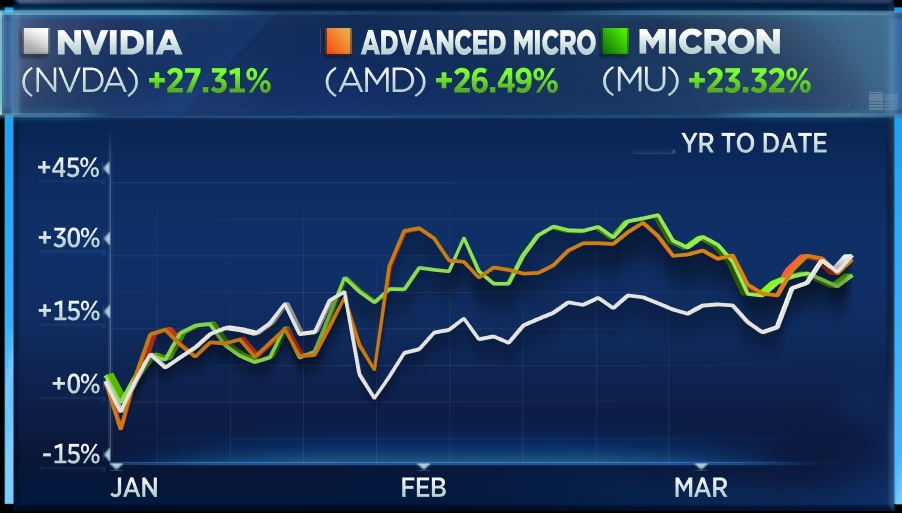
The VanEck Vectors Semiconductor ETF (SMH) — a fund that closely tracks companies in the sector — has gained nearly 22 percent since the start of the year, the best first-quarter performance since its inception in 2000. That surge outpaces the broader S&P 500's 12 percent rally. Chipmakers have now posted gains in 10 of 12 weeks to start 2019, and, on Friday, the ETF hit its highest level since early October.

The recent rally in semiconductor stocks is a sharp reversal after the SMH tumbled during the final few months of 2018. Growing trade tensions between the U.S. and China, coupled with nagging concerns about China's economic growth, rattled confidence in some of the industry's key players. Soft iPhone sales, along with a deceleration in cryptocurrency mining ventures, further fed investor anxiety surrounding weakened demand.

Taken in total, during 2018, the ETF saw its worst annual loss in a decade.

Bouncing back from brutal 2018

But, amid investors' newfound optimism and more encouraging trends in the semiconductor industry, chip stocks have rallied more than 31 percent off of their recent low hit on Dec. 26. The Federal Reserve's move to pause interest rate hikes has bolstered high-flying growth names like Advanced Micro Devices and Micron. Both of these companies are among the best performers this year, with AMD up more than 27 percent and Micron up more than 23 percent. Rising rates tend to hurt these stocks as investors adjust to the new environment.

The chipmakers' rally has come despite a mixed set of earnings reports over the past several weeks. On Friday, Broadcom jumped more than 8 percent after reporting better-than-expected results and issued encouraging guidance for the rest of 2019. But its peers have not been as successful in assuaging investors' concerns. In late January, Nvidia reported its first quarterly year-over-year revenue decline in five years, while Intel lowered its outlook for the year, citing ongoing trade concerns. Qorvo, meanwhile, issued guidance well below Wall Street expectations in its report in early February.

But that hasn't stopped investors from jumping in, as many point to improving signs about the U.S. and global economy.

"These days the semiconductor companies have their tentacles in everything," CNBC's Jim Cramer, host of "Mad Money", said this week. "Now, I often tell you that housing punches above its weight when we talk about the economy. If housing's strong, then the strength might spread to banks and retail. These days, in the new global economy dominated by data, the semiconductor stocks punch well above their weight, just like housing."

Nvidia's $6.8 billion bid to buy Israeli chipmaker Mellanox has also helped renew investors' faith in this beaten-down sector. Nvidia beat out several other potential suitors, including rival Intel, and some see the move as evidence that these companies are more aggressively pursuing new growth channels.

The deal, if approved, would mark Nvidia's biggest ever acquisition as it pushes into the growing data center market. The stock has now surged more than 27 percent to start the year, but it still down 42 percent from its most recent peak in early October.

Tail winds ahead?

Some investors see more tail winds ahead for these semiconductor stocks, and the tech sector more broadly — citing recent data showing that consumers, in the U.S. in particular, remain on solid footing.

Job vacancies jumped to a fresh high of 7.6 million in January, topping expectations, according to a Bureau of Labor Statistics report released Friday. The Job Openings and Labor Turnover Survey, which measures the level of employment vacancies as well as how many workers left their jobs and the reasons for the separations, has been indicating a continued swell of employment opportunities.

"It would be a fool's errand to bet against a fully employed U.S. consumer," Jim Lowell, CIO of Adviser Investments, told CNBC. "Today's job openings report is clearly indicative of a consumer that is very confident in near-term economic conditions, so confident that they are leaving their existing jobs to find a more interesting or better-paying job in droves. We take that as a very bullish indicator on the strength of our economy and ... the global economy as well."

show chapters Business will ramp up as a trade deal gets finalized, says expert Business will ramp up as a trade deal gets finalized, says expert    10:56 AM ET Fri, 15 March 2019 | 06:33

Still, other analysts caution that the price momentum for semiconductor stocks could falter if the ultimate terms of a U.S.-China trade deal disappoint. These companies are seeking specific measures designed to better protect intellectual property, especially in gaming and artificial intelligence. Chipmakers are also looking for concrete steps to boost merger activity following two blocked deals last year. American regulators rejected Broadcom's bid to buy Qualcomm, while Chinese regulators nixed Qualcomm's bid to buy NXP Semiconductors.

Semiconductor stocks currently sit less than 5 percent away from their all-time high set in March 2018.

— CNBC's Gina Francolla contributed to this report.

Top Medical Stocks To Watch For 2019

tags:APB,ABBV,LGND,CBK,GLBS,

Throughout much of North America, the legal cannabis movement has been unstoppable. Last year, Mexico legalized medical marijuana, while Canada is currently in the final stages of becoming the first developed country in the world to legalize adult-use weed. Even the United States has witnessed steady progression, with 29 states (and Washington, D.C.) passing broad-sweeping medical cannabis laws since 1996.

According to cannabis research firm ArcView, the North American legal pot market generated $9.7 billion in sales last year, which was up 33% from the previous year. Of course, a vast majority of aggregate marijuana sales are still conducted on the black market, giving the industry and investors hope that there's still many years of huge growth that lie ahead.

Image source: Getty Images.

Top Medical Stocks To Watch For 2019: Asia Pacific Fund, Inc. (APB)

Advisors' Opinion:
  • [By Logan Wallace]

    Media coverage about Asia Pacific Fund, Inc. (The) common stock (NYSE:APB) has been trending somewhat positive on Sunday, Accern reports. Accern rates the sentiment of press coverage by reviewing more than twenty million news and blog sources in real-time. Accern ranks coverage of companies on a scale of -1 to 1, with scores closest to one being the most favorable. Asia Pacific Fund, Inc. (The) common stock earned a news impact score of 0.10 on Accern’s scale. Accern also assigned news stories about the investment management company an impact score of 45.8681605197346 out of 100, indicating that recent press coverage is somewhat unlikely to have an impact on the company’s share price in the next few days.

Top Medical Stocks To Watch For 2019: AbbVie Inc.(ABBV)

Advisors' Opinion:
  • [By Cory Renauer]

    Gilead Sciences isn't expecting any top-line revenue growth in 2019 because expiring U.S. patents for Letairis and Ranexa could lead to a loss of around $1.2 billion. The company also expects around $900 million in lost sales because of competition with AbbVie (NYSE:ABBV) for a share of a hepatitis C antiviral (HCV) market that's been steadily shrinking. Total HCV sales plummeted from $9.1 billion in 2017 to just $3.7 billion in 2018, and Gilead's new cellular cancer therapy, Yescarta, is proving more difficult to sell than anticipated.

  • [By Ethan Ryder]

    Cambridge Investment Research Advisors Inc. grew its holdings in AbbVie Inc. (NYSE:ABBV) by 10.4% in the fourth quarter, according to its most recent disclosure with the Securities and Exchange Commission (SEC). The institutional investor owned 202,105 shares of the company’s stock after buying an additional 19,119 shares during the quarter. Cambridge Investment Research Advisors Inc.’s holdings in AbbVie were worth $19,546,000 as of its most recent SEC filing.

  • [By Stephan Byrd]

    Weatherly Asset Management L. P. lowered its stake in AbbVie Inc (NYSE:ABBV) by 20.2% during the first quarter, according to its most recent 13F filing with the Securities and Exchange Commission. The institutional investor owned 9,157 shares of the company’s stock after selling 2,317 shares during the quarter. Weatherly Asset Management L. P.’s holdings in AbbVie were worth $867,000 as of its most recent filing with the Securities and Exchange Commission.

  • [By Keith Speights]

    Shares of Voyager Therapeutics (NASDAQ:VYGR) were skyrocketing 21.7% higher as of 11:22 a.m. EST on Friday. The small biotech announced a collaboration with AbbVie (NYSE:ABBV) to develop vectorized antibodies to treat Parkinson's disease and other diseases characterized by the abnormal accumulation of misfolded alpha-synuclein protein.

  • [By Todd Campbell]

    There are more than 23 million people worldwide with rheumatoid arthritis, and despite current treatments, many patients fail to achieve disease remission or significant reductions in disease activity. The size of the addressable market and need for new drugs have made this indication a focus of drug development and new therapies from AbbVie (NYSE:ABBV) and Gilead Sciences (NASDAQ:GILD) that work similarly are fast-approaching the Food and Drug Administration's finish line. Are these stocks about to battle for billions of dollars in market share?

Top Medical Stocks To Watch For 2019: Ligand Pharmaceuticals Incorporated(LGND)

Advisors' Opinion:
  • [By Shane Hupp]

    Get a free copy of the Zacks research report on Ligand Pharmaceuticals (LGND)

    For more information about research offerings from Zacks Investment Research, visit Zacks.com

  • [By Jon C. Ogg]

    Ligand Pharmaceuticals Inc. (NASDAQ: LGND) was maintained as Buy at Argus, but the firm lowered its target to $150 from $200. The independent research firm noted that recent weakness offers a buying opportunity as the company is believed to be on track to post solid earnings growth over the next several years. Ligand closed up 1.5% at $119.76 on Tuesday, in a 52-week range of $98.56 to $278.62.

  • [By Joseph Griffin]

    Get a free copy of the Zacks research report on Ligand Pharmaceuticals (LGND)

    For more information about research offerings from Zacks Investment Research, visit Zacks.com

  • [By Keith Speights, Chuck Saletta, and Brian Feroldi]

    That's the question we presented to three Motley Fool contributors. They identified Ligand Pharmaceuticals (NASDAQ:LGND), Portola Pharmaceuticals (NASDAQ:PTLA), and Supernus Pharmaceuticals (NASDAQ:SUPN) as top biotech stocks to buy in September. Here's why these biotechs stood out:

Top Medical Stocks To Watch For 2019: Christopher & Banks Corporation(CBK)

Advisors' Opinion:
  • [By Stephan Byrd]

    Shares of Commerzbank AG (ETR:CBK) have been assigned an average recommendation of “Hold” from the twenty ratings firms that are currently covering the company, Marketbeat Ratings reports. Seven investment analysts have rated the stock with a sell recommendation, eleven have assigned a hold recommendation and two have assigned a buy recommendation to the company. The average 12-month price target among brokerages that have updated their coverage on the stock in the last year is €10.98 ($12.76).

  • [By Shane Hupp]

    Cfra set a €9.50 ($11.05) price target on Commerzbank (ETR:CBK) in a report released on Wednesday. The firm currently has a neutral rating on the financial services provider’s stock.

  • [By Lisa Levin] Companies Reporting Before The Bell Dollar Tree, Inc. (NASDAQ: DLTR) is expected to report quarterly earnings at $1.23 per share on revenue of $5.56 billion. Express, Inc. (NYSE: EXPR) is projected to report quarterly loss at $0.02 per share on revenue of $466.25 million. Dollar General Corporation (NYSE: DG) is estimated to report quarterly earnings at $1.4 per share on revenue of $6.20 billion. Tech Data Corporation (NASDAQ: TECD) is expected to report quarterly earnings at $1.46 per share on revenue of $8.13 billion. Burlington Stores, Inc. (NYSE: BURL) is estimated to report quarterly earnings at $1.09 per share on revenue of $1.49 billion. Ciena Corporation (NYSE: CIEN) is projected to report quarterly earnings at $0.3 per share on revenue of $726.56 million. American Eagle Outfitters, Inc. (NYSE: AEO) is expected to report quarterly earnings at $0.22 per share on revenue of $806.17 million. Titan Machinery Inc. (NASDAQ: TITN) is estimated to report quarterly loss at $0.08 per share on revenue of $276.27 bmillion. Donaldson Company, Inc. (NYSE: DCI) is projected to post quarterly earnings at $0.52 per share on revenue of $682.68 million. Ship Finance International Limited (NYSE: SFL) is expected to report quarterly earnings at $0.21 per share on revenue of $92.08 million. Perry Ellis International, Inc. (NASDAQ: PERY) is projected to report quarterly earnings at $0.67 per share on revenue of $232.30 million. Kirkland's, Inc. (NASDAQ: KIRK) is estimated to report quarterly loss at $0.09 per share on revenue of $140.83 million. Build-A-Bear Workshop, Inc. (NYSE: BBW) is expected to report quarterly earnings at $0.18 per share on revenue of $90.20 million. J.Jill, Inc. (NYSE: JILL) is projected to report quarterly earnings at $0.19 per share on revenue of $160.50 million. Christopher & Banks Corporation (NYSE: CBK) is expected to report quarterly loss at $0.08 per share on revenue of $89.35 million.
  • [By Logan Wallace]

    Commerzbank (ETR:CBK) received a €10.00 ($11.63) target price from equities researchers at Morgan Stanley in a report released on Wednesday. The firm presently has a “neutral” rating on the financial services provider’s stock. Morgan Stanley’s target price would indicate a potential upside of 14.60% from the stock’s current price.

  • [By Joseph Griffin]

    Christopher & Banks Co. (NYSE:CBK) reached a new 52-week high and low during mid-day trading on Thursday . The stock traded as low as $0.75 and last traded at $0.81, with a volume of 12488 shares changing hands. The stock had previously closed at $0.89.

  • [By Logan Wallace]

    Independent Research set a €9.50 ($11.05) target price on Commerzbank (ETR:CBK) in a report published on Thursday morning. The brokerage currently has a neutral rating on the financial services provider’s stock.

Top Medical Stocks To Watch For 2019: Globus Maritime Limited(GLBS)

Advisors' Opinion:
  • [By Joseph Griffin]

    Media coverage about Globus Maritime (NASDAQ:GLBS) has trended somewhat positive recently, Accern Sentiment reports. The research group identifies positive and negative press coverage by analyzing more than twenty million blog and news sources in real-time. Accern ranks coverage of public companies on a scale of negative one to positive one, with scores nearest to one being the most favorable. Globus Maritime earned a news impact score of 0.09 on Accern’s scale. Accern also assigned news articles about the shipping company an impact score of 45.6853785900783 out of 100, meaning that recent press coverage is somewhat unlikely to have an impact on the company’s share price in the next few days.

  • [By Money Morning Staff Reports]

    After looking at last week's top performing penny stocks, we'll show you a penny stock that's on the verge of crushing Cherokee's returns…

    Penny Stock Current Share Price Last Week's Gain Cherokee Inc. (Nasdaq: CHKE) $0.82 91.11 % Checkpoint Therapeutics Inc. (Nasdaq: CKPT) $3.54 51.62% TMRS Holding Co. Ltd. (Nasdaq: TMSR) $4.43 50.00% EKSO Bionics Holdings Inc. (Nasdaq: EKSO) $2.58 46.93% Jones Energy Inc. (NYSE: JONE) $0.47 46.76% TransAtlantic Petroleum Corp. (NYSE: TAT) $1.39 44.29% Inseego Corp. (Nasdaq: INSG) $2.70 42.27% Globus Maritime Ltd. (Nasdaq: GLBS) $0.44 37.85% iFresh Inc. (Nasdaq: IFMK) $2.81 33.64% Technical Communications Corp. (Nasdaq: TCCO) $4.88 29.87%

    While all of last week's 10 top penny stocks generated great returns, it's unlikely that they will be able to deliver these kinds of profits again anytime soon.

Thursday, March 14, 2019

Unreported Expenses Are Today's Filing Season Find

&l;p&g;&l;img class=&q;dam-image getty size-large wp-image-1124608886&q; src=&q;https://specials-images.forbesimg.com/dam/imageserve/1124608886/960x0.jpg?fit=scale&q; data-height=&q;640&q; data-width=&q;960&q;&g; 13 February 2019, North Rhine-Westphalia, D&a;uuml;sseldorf: View of the headquarters of trivago. The hotel comparison portal is one of the most successful German Internet start-ups. The new Trivagocampus at the media port of the state capital offers space for up to 2000 employees. Photo: Rolf Vennenbernd/dpa (Photo by Rolf Vennenbernd/picture alliance via Getty Images)

From March 8, my forensic accounting needle in a haystack comes from a travel website that left some expenses out of its initial earnings report.

Analyst Hunter Anderson found an unusual item in Trivago&a;rsquo;s (TRVG) 2018 20-F, the international equivalent of a 10-K.

On&l;span&g;&a;nbsp;&l;/span&g;&l;a href=&q;https://www.newconstructs.com/wp-content/uploads/2019/03/TRVG_SGA.png&q; target=&q;_blank&q; rel=&q;noopener noreferrer&q; target=&q;_blank&q;&g;page 6&l;/a&g;, TRVG discloses that its selling and marketing expense for the year includes 1 million Euros (~$1.1 million) that was not initially included in its unaudited fourth quarter results released on February 6. The company does not explain why these costs were not included in the original, unaudited results.

The inclusion of these costs led to TRVG&a;rsquo;s reported operating loss increasing from &a;euro;18.2 million in its press release to &a;euro;19.2 million in its 20-F, a 6% change. Investors who rely on the initial reported results before analyzing the audited financials risk making decisions based on misleading data.

Investors need to focus on &a;ldquo;&l;a href=&q;https://www.newconstructs.com/the-real-earnings-season-starts-now-finding-gold-in-footnotes/&q; target=&q;_blank&q; rel=&q;noopener noreferrer&q; target=&q;_blank&q;&g;The Real Earnings Season&l;/a&g;&a;rdquo;, when audited 10-Ks are filed, to faithfully evaluate corporate performance. Press releases are unaudited and offer inadequate information to asses economic earnings.

I&a;rsquo;ve been&l;span&g;&a;nbsp;&l;/span&g;&l;a href=&q;https://www.newconstructs.com/trivago-trvg-let-this-ipo-travel-alone/&q; target=&q;_blank&q; rel=&q;noopener noreferrer&q; target=&q;_blank&q;&g;bearish on Trivago since its IPO&l;/a&g;, and this unreliable accounting only gives us more conviction that investors should avoid this stock. TRVG is down more than 50% from its IPO price, and the stock continues to earn an&l;span&g;&a;nbsp;&l;/span&g;&l;a href=&q;https://www.newconstructs.com/stock-rating-methodology/&q; target=&q;_blank&q; rel=&q;noopener noreferrer&q; target=&q;_blank&q;&g;unattractive&l;/a&g;&l;span&g;&a;nbsp;&l;/span&g;rating.

&l;strong&g;The Power of the Robo-Analyst&l;/strong&g;

My firm analyzed 72 10-K filings yesterday, from which the&l;span&g;&a;nbsp;&l;/span&g;&l;a href=&q;https://www.newconstructs.com/technology/&q; target=&q;_blank&q; rel=&q;noopener noreferrer&q; target=&q;_blank&q;&g;Robo-Analyst&l;/a&g;&l;a href=&q;https://www.newconstructs.com/unreported-expenses-are-todays-filing-season-find/#_ftn1&q; target=&q;_blank&q;&g;&l;/a&g;&l;span&g;&a;nbsp;&l;/span&g;technology collected 4,768 data points. The analyst team used this data to make 1,165 forensic accounting&l;span&g;&a;nbsp;&l;/span&g;adjustments&l;span&g;&a;nbsp;&l;/span&g;with a dollar value of $552 billion. The adjustments were applied as follows:

&l;/p&g;&l;ul&g;&l;li&g;496 income statement adjustments with a total value of $32 billion&l;/li&g; &l;li&g;479 balance sheet adjustments with a total value of $240 billion&l;/li&g; &l;li&g;190 valuation adjustments with a total value of $280 billion&l;/li&g; &l;/ul&g;&l;em&g;Disclosure: David Trainer, Hunter Anderson, and Sam McBride receive no compensation to write about any specific stock, sector, style, or theme.&l;/em&g;

&l;a href=&q;https://www.newconstructs.com/unreported-expenses-are-todays-filing-season-find/#_ftnref1&q; target=&q;_blank&q;&g;&l;/a&g;&l;span&g;&a;nbsp;&l;/span&g;Harvard Business School features the powerful impact of our research automation technology in the case&l;span&g;&a;nbsp;&l;/span&g;New Constructs: Disrupting Fundamental Analysis with Robo-Analysts.

Wednesday, March 13, 2019

Now Trading Below Book Value: Molson Coors And 3 Other Dividend Payers

&l;p&g;&l;img class=&q;dam-image getty size-large wp-image-623294244&q; src=&q;https://specials-images.forbesimg.com/dam/imageserve/623294244/960x0.jpg?fit=scale&q; data-height=&q;710&q; data-width=&q;960&q;&g;

Once a month I screen for a certain type of value stock and was surprised to see a local Colorado favorite showing up on the list: the modern form of the old Adolph Coors brewing operation known these days as Molson Coors. That one and 3 other stocks made the grade with lower-than-the-market price/earnings ratios and now trading at a below book value price.

With the market as a whole selling at &l;a href=&q;http://www.multpl.com/&q; target=&q;_blank&q;&g;a multiple of 21&l;/a&g;&a;nbsp;(and &l;a href=&q;http://www.multpl.com/shiller-pe/&q; target=&q;_blank&q;&g;the Schiller p/e at 31&l;/a&g;), it&s;s interesting to find profitable, dividend-paying businesses with p/e&s;s of half that or about half. &l;a href=&q;https://www.goodreads.com/book/show/106835.The_Intelligent_Investor&q; target=&q;_blank&q;&g;Benjamin Graham wrote books&l;/a&g; about finding such situations -- here&s;s what seems to fit that basic value criteria right now:

&l;strong&g;Molson Coors&a;nbsp;&l;/strong&g;is New York Stock Exchange traded with the symbol, naturally, of TAP. The big beer operation is available for purchase at a 4% discount from its book value. The price/earnings ratio sits at 11.7. They are showing positive earnings last year and the 5-year record is positive as well.

&l;img class=&q;size-full wp-image-5195&q; src=&q;http://blogs-images.forbes.com/johnnavin/files/2019/03/TAP-weekly-3-13-19.jpg?width=960&q; alt=&q;&q; data-height=&q;928&q; data-width=&q;1240&q;&g; Molson Coors Brewing weekly price chart.

Problem: long-term debt exceeds shareholder equity. That&s;s a concern. Molson Coors is paying a 2.72% dividend. The short float is a big higher than you might expect at 4.9% -- if those shorts are ever forced to cover, that might cause something of a rally.

&l;strong&g;Diamondback Energy&a;nbsp;&l;/strong&g;is trading on the NASDAQ at a 10% discount to book value and with a price/earnings ratio of 12.6. Last year&s;s earnings were solidly green. The same can be said of the independent oil company&s;s 5-year record of earnings.

&l;img class=&q;size-full wp-image-5194&q; src=&q;http://blogs-images.forbes.com/johnnavin/files/2019/03/FANG-weekly-3-13-19.jpg?width=960&q; alt=&q;&q; data-height=&q;928&q; data-width=&q;1240&q;&g; Diamondback Energy weekly price chart.

Shareholder equity is greater than long-term debt, a positive. Diamondback&s;s dividend comes to .50%. JP Morgan analysts resumed their &q;overweight&q; rating for the company on March 11th.

&l;strong&g;SM Energy Company&a;nbsp;&l;/strong&g;is another independent oil and gas company that may qualify as a value stock. This one is trading on the New York Stock Exchange at a steep 39% discount to its book value. The price/earnings ratio is 3.5. It&s;s a concern that the company&s;s long-term debt exceeds shareholder equity.

&l;img class=&q;size-full wp-image-5192&q; src=&q;http://blogs-images.forbes.com/johnnavin/files/2019/03/SM-weekly-3-13-19.jpg?width=960&q; alt=&q;&q; data-height=&q;928&q; data-width=&q;1240&q;&g; SM Energy weekly price chart.

That might be part of the reason for SM Energy&s;s short float of 9.15% -- again, if forced to cover at some point, shorts can provide fuel for a rally. The company is paying a .63% dividend. In February, Macquarie analysts downgraded the stock from &q;outperform&q; to &q;neutral.&q; Barclay&s;s initiated an &q;overweight&q; rating in January.

&l;strong&g;The Greenbrier Companies&a;nbsp;&l;/strong&g;is NYSE-traded and now goes for a 2% discount to book. The railroad company has a price/earnings ratio of 9.8. Although the most recent quarter-to-quarter earnings are negative, last year&s;s earnings were positive and the 5-year record is green.

&l;img class=&q;size-full wp-image-5191&q; src=&q;http://blogs-images.forbes.com/johnnavin/files/2019/03/GBX-weekly-3-13-19.jpg?width=960&q; alt=&q;&q; data-height=&q;928&q; data-width=&q;1240&q;&g; Greenbrier Companies weekly price chart.

Shareholder equity exceeds long-term debt. The short float at 15% is higher than most NYSE stocks. That could be fuel for a rally if those with shorts are ever forced to cover. Meantime, Greenbrier pays a dividend of 2.64%.

Value stocks require the patience of a long-term investor.

Stats courtesy of &l;a href=&q;https://finviz.com/&q; target=&q;_blank&q;&g;FinViz.com&l;/a&g;.

&l;em&g;I do not hold positions in these investments.&a;nbsp;No recommendations are made one way or the other.&a;nbsp;&a;nbsp;If you&s;re an investor, you&s;d want to look much deeper into each of these situations. You can lose money trading or investing in stocks and other instruments. Always do your own independent research, due diligence and seek professional advice from a licensed investment advisor. I consult -- contact me at jnavin@gmail.com.&l;/em&g;&l;/p&g;

SpaceX and ULA Get Launch Contracts. ULA Wins Almost 50% More Money

[W]ith each passing day, I'm more and more convinced that Boeing and Lockheed's ULA joint venture is doomed to fail. Ever since the U.S. Air Force certified SpaceX's Falcon 9 medium lift rocket to carry payloads four years ago, Falcon 9 has won every bid for such missions in which it competed against Atlas V rockets bid by ULA. -- Me, eight months ago

But that was then, and this is now.

Today, SpaceX continues to charge the U.S. government significantly less (than United Launch Alliance does) for launch services. However, a pair of recent contracts totaling $739 million in value demonstrates that the U.S. government is in fact willing to pay ULA more than SpaceX for the same work -- at least sometimes. But perhaps even more important to the future prospects of ULA and its co-owners Boeing and Lockheed Martin (NYSE:LMT), ULA's rockets are getting cheaper and moving closer to price parity with SpaceX's.

Atlas V rocket launch from Cape Canaveral.

The Pentagon just ordered up three more ULA Atlas launches and three Falcons from SpaceX. Image source: Getty Images.

$739 million in space contracts

Allow me to explain.

Last month, the U.S. Air Force announced the award of six launch contracts to be divided between SpaceX and ULA. SpaceX will launch the missions designated NROL-87, NROL-85, and AFSPC-44 for a total cost of $297 million ($99 million per launch). ULA will be responsible for Silent Barker, aka NROL-107, SBIRS GEO-5, and SBIRS GEO-6. ULA will be paid $441.8 million for its three launches -- $147.3 million apiece.

And that is clearly the headline here. With $739 million up for grabs, SpaceX and ULA are being given basically the same work to do -- but ULA will be paid 49% more to do it. Now, the Air Force would probably argue that this is fair and certainly within its discretion. After all, at the time bids were solicited for these contracts last year, Space and Missile Systems Center commander Lt. Gen. John Thompson explained that awards would be based on "a trade-off between past performance, performance and schedule sub-factors, and price."

SpaceX's lower prices being the last factor in that list, USAF apparently viewed them as being of less importance than ULA's longer record of reliability and (slightly) better payload capacity to geosynchronous transfer orbit (in some configurations). I also wouldn't discount the possibility that the Air Force put its thumb on the scales and awarded half its launch business to ULA in an effort to ensure there remain at least two horses in this race -- so that the government can continue to play one against the other to extract better prices from each.

Giving credit where it's due

But let's also give credit where credit is due: The Air Force's plan is working.

Even if ULA is still charging a lot more than SpaceX does, and for essentially the same work -- and even if the government is still voluntarily paying that premium -- ULA CEO Tory Bruno has made significant progress in lowering the cost of the launch services it sells to the government so as to better compete with SpaceX. (It's also worth noting that this hasn't yet done any obvious damage to ULA's profit margins. In fact, ULA co-owner Lockheed Martin, which breaks out results for its space business separately, showed a small uptick in space profit margins in 2018, according to data from S&P Global Market Intelligence.)

Just two years ago, in surveying the prices charged by various launch providers for their services, I noted that according to ULA's published figures, one of ULA's cheaper Atlas V missions was still expected to cost $164 million, and "launch costs across its entire fleet average $225 million."

At an average launch cost of $147.3 million, last month's contract awards show that at the very least, ULA seems to have succeeded in shaving 10% off its launch cost -- and potentially as much as 35%. (Because ULA doesn't publish a detailed price schedule, we don't know precisely how much it has charged for past launches using the Atlas 5-421 configuration that it will be using for the two SBIRS launches. This makes it hard to do an exact apples-to-apples comparison between launch prices then versus launch prices now.)

But we do know that ULA is offering at least some price improvement and that these better prices are being offered on not just any missions but on missions so complex and secretive that they're only known by code name (e.g., Silent Barker, believed to be a "collaborative [intelligence] acquisition" program run by the National Reconnaissance Office and U.S. Air Force). Such missions almost certainly involve more government red tape and higher expenditures to ensure mission success than simply lofting a commercial TV satellite into orbit, for example.

Yet ULA has managed to cut its prices regardless -- and thanks to competition from SpaceX, the U.S. government has managed to make ULA cut its prices in order to win contracts.

This still doesn't seem exactly fair to SpaceX, but it's a win-win-win for ULA, the USAF, and taxpayers.

Tuesday, March 12, 2019

Wuhan General Group (BEST) Shares Up 5.4%

Shares of Wuhan General Group (China) (NASDAQ:BEST) shot up 5.4% on Monday . The stock traded as high as $6.02 and last traded at $5.90. 1,940,524 shares changed hands during trading, an increase of 102% from the average session volume of 960,030 shares. The stock had previously closed at $5.60.

Separately, Zacks Investment Research upgraded Wuhan General Group from a “sell” rating to a “hold” rating in a research report on Tuesday, March 5th.

ILLEGAL ACTIVITY NOTICE: “Wuhan General Group (BEST) Shares Up 5.4%” was first reported by Ticker Report and is owned by of Ticker Report. If you are reading this story on another domain, it was copied illegally and reposted in violation of US & international copyright & trademark law. The correct version of this story can be read at https://www.tickerreport.com/banking-finance/4214426/wuhan-general-group-best-shares-up-5-4.html.

Wuhan General Group Company Profile (NASDAQ:BEST)

BEST Inc operates as a smart supply chain service provider in the People's Republic of China. Its proprietary technology platform enables its ecosystem participants to operate their businesses through various SaaS-based applications. The company applies its technologies to a range of applications, such as network and route optimization, swap bodies, sorting line automation, smart warehouses, and store management.

Featured Story: What is the Dow Jones Industrial Average (DJIA)?

Monday, March 11, 2019

Grupo Supervielle (SUPV) Q4 2018 Earnings Conference Call Transcript

Logo of jester cap with thought bubble with words 'Fool Transcripts' below it

Image source: The Motley Fool.

Grupo Supervielle (NYSE:SUPV) Q4 2018 Earnings Conference CallMarch 8, 2019 9:00 a.m. ET

Contents: Prepared Remarks Questions and Answers Call Participants Prepared Remarks:

Operator

Good morning, and welcome to the Grupo Supervielle fourth-quarter 2018 earnings call. A slide presentation will accompany today's webcast, which is available in the investors section of Grupo Supervielle's investor relations website, www.gruposupervielle.com. [Operator instructions] As a reminder, today's conference call is being recorded. At this time, I would like to turn the call over to Ana Bartesaghi, treasurer and IRO.

Please go ahead.

Ana Bartesaghi -- Treasurer and Investor Relations Officer

Thank you. Good morning, everyone, and thank you for joining us today. Speaking during today's call will be Patricio Supervielle, our chairman of the board of directors, who will discuss the overall macro environment; and Jorge Ramirez, our chief executive officer and vice chairman of the board, who will review our results for the quarter. Also joining us is Alejandra Naughton, chief financial officer.

All will be available for the Q&A session. Before we proceed, I would like to make the following safe harbor statement. Today's call will contain forward-looking statements, and I refer you to the forward-looking statements section of our earnings release and recent filings with the SEC. We assume no obligation to update or revise any forward-looking statements to reflect new or changed events or circumstances.

I would now like to turn the call over to Chairman Patricio Supervielle.

Patricio Supervielle -- Chairman of the Board of Directors

Thank you, Ana. Good morning, everyone, and thank you for joining us today. If you're following the presentation, please turn to Slide 3. It was a challenging year, yet we are able to make progress.

We almost doubled attributable comprehensive income year on year in the fourth quarter and posted a 7% sequential increase. Importantly, we met our annual profitability target operating in a challenging macro environment that was worse that originally anticipated. Moreover, we achieved these even as we decided to increase our loan-loss provision meeting a 100% NPL coverage goal, one year ahead of plan. Our franchise continues to demonstrates its resiliency and flexibility to navigate a macro scenario of low credit demand and macroeconomic challenges.

In a high interest rate environment, coupled with soft loan demand, increased liquidity is being invested in low risk short-term central bank securities. This resulted in net financial margins slightly above 20%, up both year-on-year and sequentially. For the next few minutes, I'm going to provide an overview of the key macro indicators to put into context, how it is impacting the overall Argentine economy, the financial industry and more specifically, our company. Jorge will then discuss our results for the quarter in greater detail and our -- an outlook for 2019.

Turn please to Slide No. 4. Fourth-quarter macroeconomics was characterized by high inflation following the sharp peso devaluation in the prior quarter. Following the agreement with the IMF, new monetary policy rules and FX bans, the FX stabilized, while interest rate started to decline, although still remaining at high levels.

The monetary policy rate reached 59% at year-end from a high of 74% in early October. And the average Badlar rate, the benchmark rate for the Argentine financial system, becomes slightly just below 50% at year-end. Economic activity seems to have reached an inflection point at the close of the year. For example, the December monthly GDP proxy is the MA, posted a 0.7% month-over-month increase.

Imports has also shown -- have also shown a monthly seasonal improvement over the past couple of months. Nevertheless, the recovery is expected to be slow, impacted by the contractionary monetary and fiscal policy mix. Additionally, the political environment also makes for more cautious scenario. Economist consensus in U.S.

calls for a GDP contraction of 1.3% in 2019 with a weaker performance in the first half of the year as recovery in the second half. For 2020, GDP growth is anticipated at 2.5%. Looking ahead market consensus also anticipate a scenario of further declines in inflation reaching 39.9% for 2019 and 20.3% for 2020. Monetary policy rates are also expected to decline to 37% by year-end.

We also continue to experience unusually high minimum reserve requirements of approximately 45% of demand deposits and 35% of time deposits. We expect these requirements to gradually decline as the credit dynamics normalize over time. In any event, as Jorge will explain later, we do not assume a reduction in this minimum reserve requirement in our 2019 outlook figures. Please turn to Slide 5.

Moving on to the Argentine financial sector. Argentine-denominated deposits expanded 19% sequentially in the quarter, while dollar-denominated deposits continue to increase, up 7% in dollar terms. Deposit growth measured in original currency is decelerated in January and remain relatively flat in February, reflected seasonality with the system remaining and highly liquid levels in this high interest rate environment. By contrast, system loan growth decelerated during the quarter against the difficult macro backlog.

Peso-denominated loans contracted nearly 2% sequentially in fourth-quarter 2018 and around 1% in each of the first two months of 2019. System dollar-denominated loans measured in U.S. dollars, in turn, contracted nearly 4% quarter on quarter by the increase this year, up 1% in January and just 2% -- and just under 2% in February. We experienced relatively single trading loans, while we reduced deposits toward the close of the quarter, reflecting excess liquidity management by our treasury.

Average deposit balances has, however, increased 15% sequentially. I will now turn the call to Jorge, who will review our financial performance and outlook. Please Jorge, go ahead.

Jorge Ramirez -- Chief executive Officer and Vice Chairman of the Board

Thank you, Patricio. Good day, everyone. Starting with the evolution of our asset base, our assets were up 4% sequentially. As the central bank finished rewinding Lebac stocks in the quarter, we capture a higher share of non-financial institutional deposits, mainly five wholesale deposits, to fund investments in high margin seven-day Leliq securities, issued by the central bank.

Towards the close of the year, we renews our holdings in these Leliqs to manage excess liquidity in the current environment. Our loan book in turn contracting nearly 4% quarter on quarter. Both these together resulted in a sequential decline in assets of slightly over 3%. Turning to Slide 7.

In a weaker environment characterized by soft loan demands, together with the tightening of credit scoring and for segments earlier in the year, peso-denominated loans were relatively stable, increasing about 1%. Foreign currency loans measured in U.S. dollars, in turn, were down 8%. This softer environment is the main reason for a year-on-year loan book growth of 32%, below our guidance range of 40 to 50% for 2018.

In line with the current market conditions, our exposure to our consumer finance segment remains below 10% of our total portfolio, at similar level to the prior quarter and down from 13% in the same quarter last year. The share of the corporate loans fell to 50% from 54% in the third quarter. This mainly reflect the impacts of the Argentine peso appreciation on U.S. dollar-denominated loans combined with a reduction of this portfolio measured in its original currency, as we continue to adjust our risk appetite.

Moving on to Slide 8. As a result of the foreign exchange dynamics, and overall soft loan demand in a recessionary environment, as I just explained, the corporate book contracted nearly 11% sequentially. In original currency, peso loans were down 6%, while our U.S. dollar-denominated loans fell 8%.

Retail loan growth continued to decelerate at 5% quarter on quarter of the back of softer mortgage demand in the current market. Our consumer finance loan portfolio in turn contracted again in the quarter, down 5% sequentially in line with our risk appetite in this economic scenario. Finally, our portfolio remains highly optimized and well diversified among a wide range of economic sectors, while maintaining growth collaboration levels. Turning to Slide 9.

Average deposits in the quarter were up 15% sequentially. Deposit balances, however, declined 2% in the period, as we manage excess liquidity toward year-end, particularly, we decided to reduce the balance of special checking accounts with 26%. Both the loans-to-deposits and loans-to-asset ratios continue to decline reflecting overall high liquidity and weaker loan demand. This year, our foreign exchange deposits remains stable at 33% of total deposits, as the Argentine peso appreciation in the quarter offset the 5% increase in U.S.

dollar-denominated deposits measured in original currency. Moving on to funding on Slide 10. Retail and senior deposits increased the share of total deposits up to 44% from 40% in the third quarter, while corporate deposits accounted for nearly 20%. The share of non-interest-bearing deposits accounted for a sizable portion of the total deposits come increasing to 39 from 37% in the prior quarter.

Moving on to our P&L on Slide 11. Net financial income rose 20% sequentially. Larger average values of assets and deposits, together with higher interest rate were the main drivers behind this performance, which was partially offset by higher cost of funds. That I think the margin of our loan portfolio increased by 130 basis points sequentially.

Both our Argentine peso and U.S. dollar portfolio contributed into this increase. Net financial margin expanded 210 basis points, reaching 20.3% in the quarter, up from 18.2% in the prior quarter. This combined high yield from the loan portfolio as we continue to reprice and high Leliq rates in the peso-denominated portfolio.

For the full year, net interest margin reached 19.4% in the higher end of our 18% to 20% guidance range. Remember two accounting considerations: first, net income from financial instruments benefits from the peso yield on holdings of both short-term central bank securities Leliq and dollar-denominated from the securities, Lebac. However, net interest income is penalized by the cost of deposits confirmed these investments. Second, as mentioned, net income from financial instruments include the peso yield of U.S.

dollar-denominated government securities, but does not include the foreign exchange gain or loss on dollar deposits taking to fund these securities. In the 4Q '18, as a result of the appreciation of the peso, the peso yield of dollar-denominated securities decline, as well as the peso cost of these U.S. dollar deposits. Turning to Slide 12.

Net service fee income growth remained soft in the quarter, up 4% sequentially. We experienced a dropping fees charged -- fees charge driven by a weak corporate loan origination together with higher commissions, paid mainly to debit and credit card processor. At the same time, income from insurance activities declined close to 2% quarter on quarter. We experienced seasonally higher grain ratios in the quarter together with a runover of our trade-related policies.

Moving on to asset quality on Slide 13. We proactively stepped up total NPL coverage to 100% a year ahead of plan. This compares to 94% coverage in the third quarter and 88% in the 4Q '17, reaching 100% coverage for the cost of risk up to 7% from almost 6% in the prior quarter. Excluding the 231 million pesos this quarter in addition to loan loss provisions, cost of risk would have remained flat sequentially.

Excluding also 120 million pesos loss provisions rate in the third quarter to increase coverage to 94%, cost of risk for the full year would have been 5.2%. This is slightly above the top end of our 4.6% to 5.1% annual cost of risk range as increased inflation impacted consumers' disposable income and the high interest rate environment hit the companies. The NPL ratio increased 40 basis points quarter on quarter to 4.1%. The corporate segment reported a 30-basis point increase in the NPL ratio, reaching 1.1%, remaining at historical lows.

With the banking proceeds at 90 days toward the delinquency ratio of 2%, below the 3.3% NPL ratio reported in the fourth quarter, reflecting the large share of payroll customers, which help better performance. In contrast, due to lower loan origination and the impact of inflation to customers' disposable income, the consumer finance segment reported 90 basis points sequential increase in its NPL ratio. Taking a deeper look at asset quality for the consumer finance business on Slide 14. This business is the most affected by inflation.

As you can see, three months vintage data and NPL creation, remain well below peak levels, experienced in the first half of the year. Vintages taking February of last year and NPL creation in the second Q '18, decline as we introduced our stringent credit scoring standard in the first quarter of the year to adjust to the challenging macro environment. However, the sharp increase in inflation experienced between September and November, resulted in summary duration in these metrics toward year-end. Preliminary data for 2019, gives us room to be optimistic.

Moving on to expenses on Slide 15. We saw a sequential deterioration of 260 basis points in the efficiency ratio, reaching 61.9% in the fourth Q '18, mainly due to regulatory salary increases. On an annual basis, efficiency improved to 61.5% from 67% in 2017, in the middle of our 59% to 63% guidance range. Next, Slide 16.

We almost doubled attributable comprehensive income year-on-year in the quarter and focused -- and posted a 7% sequential increase. Attributable net income was on -- were 50% year-on-year and remained flat quarter over quarter, when excluding the increase in NLPs to reach 100% NPL coverage ratio ahead of time. Return on average equity for the quarter reached 32.6%, up 20 basis points from the prior quarter, while return on average assets remained relatively stable at 2.6% sequentially. For the full year, we delivered attributable comprehensive income of 3 million pesos, up 61% and in line with our 2.9 to 3.3 million guidance range.

We achieved this, despite the more difficult than originally anticipated macro backdrop and the decision to step up the coverage of range, 100% NPL coverage. Moving on to capitalization on Slide 17. Consolidated pro forma Q1 capital ratio rose 40 to -- 40 basis points to 12.9% at year-end. This in line with our top end of our 12 to 15% guidance range.

The chart on this slide compares to a Q1 ratio for the fourth quarter against March the 2018. Before the sharp peso devaluation, that took place late during the year. As you can see, the impact of the special evaluation on our credit risk-weighted assets resulted in 120 basis points capital consumption in this period -- but more importantly, capital creation contributed with 150 basis points increase in Q1, exceeding the 130 basis points consumed in our risk-weighted assets increases in the period. During the quarter, we made capital injections of 1.3 million pesos Banco Supervielle and Mila.

A total of 927 million pesos remain at the holdco future capital injections. Please turn to Slide 18. In summary, as we said before, while the macro environment turned out to be worse than we originally anticipated at the time presented the guidance, we met our annual profitability targets. The strength and flexibility of our business model was evident in 2018 as we have to navigate through randomly changing macro and credit volatility.

Importantly, we have the franchise well positioned to return to growth in an improving macro environment. Let me now share with you, our guidance for 2019 and some of the underlying assumptions, which you can see on Slide 19. Despite limited visibility in the current rollout time and economic environment, we are keeping the policy of providing annual guidance. But note, we're presenting wider guidance ranges for 2019 than in previous years.

Based on our macro assumptions, as Patricio discussed at the start of the call, we expect a number in the range in the 21% to 31%, with assets and deposits growing in line with inflation. At the same time, we expect cost of risk of between 5% to 5.8% in 2019, assuming NPL coverage remains at 100%. We also anticipate NIM to remain in the 18.5% to 20.5% range for the year. Note that as of the first quarter of 2019, we will adjust our NIM calculation to also take into account exchange rate differences and net gains or losses from currency derivatives.

Until now, our NIM only included interest income and interest expense, as well as relaunch on the investment portfolio. With these additions, our NIM ratio remain more accurate and representative for the financial margin spreads. Consequently, we will stop reporting net financial margin as NIM will capture all the components of our net financial margin. Our guidance also calls for the efficiency ratio, reaching levels of between 61% to 63% for the full year.

While improving efficiency remains one of our strategic goals, the full impact of the salary increases, given resilient inflation impose a challenge. Note that, starting 2019, we are providing net income guidance instead of comprehensive income. Net income in 2019 is anticipated to increase between 28% to 52%, reaching between 3.3 to 3.9 billion pesos in the year from net income of 2.6 billion in 2018. Comprehensive income in 2019 is expected to be above 2018.

Given our expectations with the above metrics, the Tier 1 ratio is anticipated to range between 10.6 and 11.1% at year-end. Operator, please open the floor for questions. 

Questions and Answers:

Operator

[Operator instructions] Our first question is from Jason Mollin with Scotiabank. Please proceed with your question.

Jason Mollin -- Scotiabank -- Analyst

Hello, everyone. Thank you for the opportunity to ask a question. My question is on your 2019 outlook guidance and potentially 2020 and beyond. You've given very clear metrics that this guidance is based on GDP growth of 1.3%, inflation of 32%, your outlook for Badlar, etc.? Where do you see the various scenarios, let's say, a weaker-than-expected scenario and a better-than-expected scenario, how that could play out.

How that may be tied into the upcoming elections [Audio gap] the outlook for the FX that could really drive these different scenarios, how should we think about this? And what would -- what could drive your expectations to be at the low or high end or even be higher or lower than you're expecting?

Jorge Ramirez -- Chief executive Officer and Vice Chairman of the Board

Just one clarification. Our expectations for the GDP for this year have declined 1.3%, not a growth. But this aside, I mean, seems to be a very vital year in terms of how things play out. And I mean, we are expecting in any of the scenarios, the first half of the year to be tougher than the second half of the year and with the biggest caveat being the kind of volatility or uncertainty that the upcoming elections might bring to the table.

But clearly the economy should start improving from second quarter on, essentially because we are expecting a record harvest for this year compared to, one of the most severe drops in the past 50 years, that we have last year. So just by comparables, let's just start showing improvement for the economy to start performing better. On the other hand, I mean, pardon me, and that has a very major impact especially in the second quarter because that is the downward cash-rich quarter in Argentina, it's normally the quarter of year in which the Banco -- I mean, this is exports, currency -- our currency are liquidated in the country. On top of that, the company still has around $10 billion million from the IMF, that they can then use in order to keep the currency under control.

So if inflation starts coming down and as we move toward the second queue and clearly the central bank might have the tools in order to start bringing the inflation down and correct some of the cash reserve requirement. So cash reserve requirements currently are having a dual effect, no wonder, it's their increasing interest rate. And then as a result of that, they are clearly making it substantially less attractive for people and for companies to borrow money. So anyway, actually in the cost reserve requirement, even though interest rate might still remain high, it will have the impact of posting deposit rate raising, essentially, because the gap between the rates for deposits and the rates for interest rates, which is currently very wide, could start narrowing.

So we're expecting effects FX at the end of year to be at 48%. Clearly, I think we are going to have unvisited scenarios depending on the outcome of the elections. It could be below that if we have a postelection running. It could be above that we have lots of good news in the elections.

And a lots of news, what I mean is, a turn back toward -- if they results, policies that have already phased in the past. That's what I mean by that. So if anyone is cares what the currency might end up being in the given scenario. So we believe that the rate, which we have provide, take into account as much as possible of these binary scenario that we are expecting.

But again, this is Argentina, so the frequency with which highly unlikely scenarios tend to happen, is very frequent. So.

Jason Mollin -- Scotiabank -- Analyst

That's very helpful. Just as a follow-up. I mean, if you try to quantify, like its -- the median outlook or the base case outlook is, as you said, negative 1.3% real GDP growth. What's the worst case and what's the best case in that scenario?

Jorge Ramirez -- Chief executive Officer and Vice Chairman of the Board

My take would be probably worse case would -- could be around two -- minus two. Best case could be still negative, but between 0.5 percentage points and I mean, it's 2% flat.

Operator

Our next question is from Mario Pierry with Bank of America Merrill Lynch. Please proceed with your question.

Mario Pierry -- Bank of America Merrill Lynch -- Analyst

Good morning everybody. Let me ask you two questions as well. The first one is related to your loan portfolio NIM, right? If we look at Slide 11, you showed that you're NIM for your local currency loans, range from 22.5 to 25.3% in one year. So I was wondering, how far into the repricing of your loan book are you? Meaning, how much more upside is there for NIMs to continue going up, given the maturity or the duration of your loans? That's question No.

1.

Jorge Ramirez -- Chief executive Officer and Vice Chairman of the Board

Mario, I think we are pretty, well ahead in terms of pricing of our loan book. I mean, the corporate portfolio has been fully repriced and the retail portfolio, I would say, both in consumer and retail bank is fairly fully repriced. However, we believe there still might be some room essentially, if interest rates -- if funding interest rates come down because that will have a very positive impact on consumer finance portfolio. We just -- you -- probably we go, does not waste retail deposits, it has to fund itself in the market.

So any drop in interest rates it helps that company and it helps that business. And also we have those in the retail bank where we do have a larger share of personal loans. So any expectation of improvement, which will leave, might still be some room for that. And we don't expect it to come from the repricing on the asset side, but mostly on the repricing on the liability side.

Mario Pierry -- Bank of America Merrill Lynch -- Analyst

OK. Second question is related to your cost of risk guidance. You expecting pretty much cost of risk to come down in 2019. So if you can help us understand, when do you expect NPLs to peak? And does your guidance consider you maintaining a coverage ratio of 100%? Or is that declining?

Jorge Ramirez -- Chief executive Officer and Vice Chairman of the Board

Yes. We're expecting NPLs and credit quality to peak in this -- around the second quarter of the year. It does include the cost of risk, does include the expectation of us maintaining 100% coverage for the year. And --

Alejandra Naughton -- Chief Financial Officer

More than five.

Jorge Ramirez -- Chief executive Officer and Vice Chairman of the Board

Yes, and NPLs --

Alejandra Naughton -- Chief Financial Officer

Sorry, Mario, I was adding some color regarding NPL, that we expect to be reaching by -- at year-end a number close to five. But anyway, I will highlight, again, that the guidance of cost of risk and this comment that they are making regarding NPL is the full year. So, you could be observing higher levels along the year because the cycle of economy could be working by the middle of the year. That's -- it is very important for us to highlight -- of course, we will be following the numbers quarter over quarter.

However, the guidance is full year. So, if you really observe some deterioration in the middle, it doesn't mean for us, according with information we have up till now, that it could be a trend to consider the guidance for 2019.

Jorge Ramirez -- Chief executive Officer and Vice Chairman of the Board

Yes. So just to add on that answer. We are expecting to have the 100% coverage -- to maintain the 100% coverage by year-end and, if possible, above the 100% ratio. However, throughout the year, we might see some movements because, again, it will depend on when some of the further credit quality issues might hit us in terms of quarter end, OK? So some of them might get anticipated.

Some of them might get delayed. But the idea is to end up the year and the figures account to that that we're going to end up the year on a 100% coverage.

Mario Pierry -- Bank of America Merrill Lynch -- Analyst

OK, now that's very clear. Thank you.

Operator

Our next question is from Gabriel Nobrega with Citi. Please proceed with your question.

Gabriel Nobrega -- Citi -- Analyst

Thank you for the opportunity to ask questions. I actually wanted to pick your brains and maybe understand what is going to be the strategy for the bank this year to maybe manage your excess liquidity. And here, I just wanted to understand, mainly as loan demand has been decreasing a lot, and at the same time, we have begun to see that the central bank is actually reducing interest rates and could even reduce them further through the years. So, I just wanted to maybe get a bit more sense from you on what is the strategy here.

Jorge Ramirez -- Chief executive Officer and Vice Chairman of the Board

OK. I mean, clearly the strategy is here. The name of the strategy that we've been following since the second q of last year is flexibility because you need to have a lot of flexibility in terms of having moved the different pillars of a business and when you go through an environment like the one we've been traversing since early second q of last year. What I mean by that is that we're using the investments in central bank notes as a way of compensate for weaker loan demand and more stricter and increased policies and risk appetite, OK? But at the same time, we're trying to keep the flexibility in the franchise to be able to go back to growth in our basic business, which is our commercial -- we're commercial lenders.

I mean, that's essentially our DNA and our spirit. So we want to go back to that. But in order for that to happen, we need the economy to stabilize and the macro environment to stabilize. So in the meantime, you have to -- we're using this excess liquidity as a flexibility tool in order to invest in this Leliqs, all the excess liquidity that we're generating.

So, regarding your -- the second part of your question is in terms of how interest rate compression hit us. Remember that the cost of funds for a consumer finance company is determined by the interest rates levels of Leliqs. So, the higher the Leliq rates, the higher cost of funds for the consumer finance company. The lower they are, the lower the cost of funds they have.

And they point on average loans at -- between 75% to 90% APR. So, the -- any reduction in the rate of the Leliq has an impact on the bank, but it -- which is compensated by the increasing NIMs names in our loan portfolio, mostly on a consumer finance company but also on a retail bank. So, in that sense, we have pretty well-hedged balance sheet on a consolidated basis. So, this is the way that we look at it.

Clearly, for us, in the long term is a much better scenario, a scenario of lower interest rates than the current scenario of high interest rates.

Gabriel Nobrega -- Citi -- Analyst

All right. That sounds very clear. And if you allow me to actually make a second question, could you just share more details on how the turnaround of your consumer finance business has been going so far? Also, could you maybe share with us what are the key metrics that you are tracking in order to become more comfortable with the situation of this business going forward?

Jorge Ramirez -- Chief executive Officer and Vice Chairman of the Board

OK. I mean, the consumer finance business has been, as I explained in the presentation, clearly, the business has been most affected by this high interest rate environment and high inflation. Essentially, because of its cost of funds; and second, because inflation hits -- inflation and other utility prices affect the disposable income for the segment of population which is some customer -- represent our customer base in this segment. So clearly, when we announced transition of the business in August, that was prior to the change in central bank's monetary policy of the bank increasing interest rates that we had by the end of August or early September of last year.

So the situation was even harder than we had originally anticipated when we started reorganizing the business. We've been able to streamline the operation. We did some reaction, very important one. So we're bringing down costs as the expectation for cost increases for that business for this year are very, very low, in the range of between 5 to 7% year-on-year.

So that's revenues in that sense. We've been taking a lot of measures in terms of improving our collections. And we're showing -- and that is already paying off. That was what I was meaning when I mentioned in the presentation that the preliminary data for the business in 2019 gives us room to be optimistic because essentially, we're seeing improvements in collections in all the different buckets that we have in the business.

Again, it's still early in the game. As I explained earlier, this is a very vital year, so things can go -- can still go south. But we're seeing that happening very well. In terms of the metrics that we're following, and I measure a lot the size of the portfolio, bad loan formation, the early stages of delinquency in the early buckets, like 30-plus because that is a very good -- lead indicator telling us how delinquency is going to be in the next 60 or 90 days.

And clearly, cost of funds and returns on the asset side of the business is another of the metrics that we follow up very closely. Finally, just one further point. We have, as part of the organization we're in, is we started to increase cross-selling or sales of nonfinancial services and products in that segment. And that is also progressing well.

It's still at modest levels, but we have good expectations at that as a way of originating nonfinancial income from this segment.

Gabriel Nobrega -- Citi -- Analyst

All right. That's very clear. Thank you so much.

Jorge Ramirez -- Chief executive Officer and Vice Chairman of the Board

Pleasure.

Operator

Our next question is from Ernesto Gabilondo. Please proceed with your question.

Ernesto Gabilondo -- Bank of America Merrill Lynch -- Analyst

Hi, good morning, Patricio, Jorge, Alejandra and Ana. My question is related to the implementation of inflation accounting that I think you're going to give more details in the 20-F report next month. But can you provide some color on what could be the impact for net income and ROE in 2018?

Alejandra Naughton -- Chief Financial Officer

Hello, Ernesto. As you mentioned, since the bank in Argentina adopted inflationary accounting standards, from January 1, 2020. However, we will be disclosing those numbers in the coming filing of our 20-F because Argentina was included in the list of hyper inflationary countries. Preliminary numbers for us that shows that our return on equity would have resulted in a negative 10%.

And result into, let's say, close to 1.5 billion losses from our nominal profit of 3 billion.

Ernesto Gabilondo -- Bank of America Merrill Lynch -- Analyst

Perfect, perfect. And then just a second question regarding your OPEX line. So you grew around 35% in 2018. But given that we continue to see high inflation levels, and you are seeing negotiations with unions demanding to rise wages.

Will you see this line could be growing at the same pace in '18? Or even it could be growing at a higher pace this year?

Alejandra Naughton -- Chief Financial Officer

The thing is that clearly, I mean, cutting the expenses in this inflationary environment is a huge challenge. So just to give you some color regarding our model, we have -- and as I said the expenses for personal growing and close to high 30s or 40% increase. And on the interest, the expense is a little bit lower, low 30s. And it has to do with the situation that personal expenses has -- it carries from the increases experiences during 2018.

So you have taken 2019 projects one, they carry from the gradual increases around the year during 2018, this carry could be representing a number close to 25% increase, plus the expectations regarding inflation for this current year. So, all in all, our revenue expenses would be growing during the year in a number close to high 30s, combining as interest expenses and personal expenses.

Ernesto Gabilondo -- Bank of America Merrill Lynch -- Analyst

Perfect. Thank you very much, Alejandra.

Alejandra Naughton -- Chief Financial Officer

You're welcome.

Operator

Our next question is from Yuri Fernandes with JP Morgan. Please proceed with your question.

Yuri Fernandes -- J.P. Morgan -- Analyst

Oh, thank you, Jorge, Alejandra. I had a follow-up on Ernesto on these expenses, growth. I recall last year, you had some impact from adaptation like an early retirement kind of program, that was about 200 million pesos. And last quarter you also said -- you also had some impact from the head cost reduction due to some refinance.

So just pointing these to ask about the pace of the growth on personal expenses, so we are just by that, we are seeing personal expenses growing about 60% year over year. And my question here is, if there is anything else here in the end of the 4Q, any kind of -- or adjustment that you had to do regarding the previous salary's increase? Because 60% pace for salaries is a bit high for me. So that's my first question. And my second question is regarding your Q1 ratio in your guidance.

I just want to like to check if that number, the 10.6% in the lower end you have in the guidance for '19, if that includes the excess cash in the holding company and the capitalization that was approved by the central bank in January?

Alejandra Naughton -- Chief Financial Officer

OK, in terms of administrative expenses, you have -- first and very important, we do not have or had any further initiative regarding early retirements and the situation that you mentioned corresponding to 2017. So that the numbers, as I share two minutes ago, of an increase of 37% is clearly the dynamic of the company that is facing this high inflationary environment and the changes in headcount that is considerably different within this segment, let's say, while we are using the headcount in consumer finance, you could be observing some increase marginally on the bank subsidiary. Because the nature of the business and the dynamic of the business is different. So, this is my answer for you on that regard.

The second question was regarding, sorry?

Yuri Fernandes -- J.P. Morgan -- Analyst

The Tier 1 ratio on your guidance --

Alejandra Naughton -- Chief Financial Officer

Ah, the Tier 1--

Yuri Fernandes -- J.P. Morgan -- Analyst

The 6 to 11.1, if that includes their excess case, it's like the adjusted number?

Alejandra Naughton -- Chief Financial Officer

Thank you. Yes, exactly. We also -- always offer the guidance, that Tier 1 which we call the pro forma Tier 1, that includes that money. And along the year, we would plan to have some capital injections, particularly on the bank subsidiary and in cascade, one on the consumer finance segment.

But it will be included.

Yuri Fernandes -- J.P. Morgan -- Analyst

OK. If I may, a final one here, Alejandra. On Gabrielle's question regarding our strategy of excess liquidity, it's really caught my attention here, the decline on the deposit, the decline on assets, quarter over quarter given the inflation is running, I don't know, above 10% on a quarterly basis. So, my question here is just to understand, and I totally agree, like, your loan-to-deposit ratio and your decline is close 80%.

But still, given the high inflation environment, it's really called my attention that as total assets are declining. So, my question is, if we should expect this to go on? And also, if this is somewhat related to the decline on the number of active clients? I think there was a small decline, 1.9 -- 1.8 to 1.9 million clients, active clients. So, if you're being, I don't know, like, if your strategy is basically to not provide kind of funding, I don't know, new kind of relationship with clients. Just to understand, how you are managing this excess liquidity? How are you managing these with clients?

Jorge Ramirez -- Chief executive Officer and Vice Chairman of the Board

Yuri, this is Jorge. No, I mean, it does not have to do with the franchise or with the number of customers. This was a year-end event, and it had to do with -- I mean, if you look at the average deposits for quarter, you compare the growth, we had a 15% growth in deposits in the -- our average deposits of the quarter. So, we're holding money on the averages, we're holding money on year-end balances.

So, this was only a matter of -- when we took the picture and the risk return of investments compared to one day or side deposits that are iterated. I mean, if you look at the bulk of the reduction, it comes from special check accounts that are 100% institutional -- it's 100% institutional funding. You cannot see yet the figures for us in 2019, but if you would see them -- if you will be able to see them, you would see that that has come back up. So, it was only the leverage at the end of the year that have to do with internal metrics and us managing excess liquidity when we didn't see the right trade-off between risk and return.

Operator

[Operator instructions] Our next question is from Carlos Gomez with HSBC. Please proceed with your question.

Carlos Gomez -- HSBC Securities -- Analyst

I would like to complement the question about inflation accounting. How would your shareholders' equity have been, I would imagine, it'd have been higher than what you reported under the inflation accounting? And second also on the Tier 1 ratio, again, 10.6, 11.1 is not very high level. At what level would you think you might want to consider another capital increase?

Alejandra Naughton -- Chief Financial Officer

OK. Carlos, regarding net worth, we posted net worth as of December of 17 billion on the adjusted value inflation. That number would have been number close to 18 billion.

Carlos Gomez -- HSBC Securities -- Analyst

OK. So --

Jorge Ramirez -- Chief executive Officer and Vice Chairman of the Board

Hi, Carlos, this is Jorge. Regarding the second part of your question, probably we are closer to the 10% mark, we would consider raising it up. We still have options in terms for us to raise. We have that bucket, it's currently empty.

So we have some things that we can do, but I think that 10.6% is -- or around that figure, which is 10.6 and 10 is our minimum comfort level.

Carlos Gomez -- HSBC Securities -- Analyst

Yes. And just to clarify this 10.6 to 11, this is the capital ratio of the bank, of Banko Supervielle?

Jorge Ramirez -- Chief executive Officer and Vice Chairman of the Board

No, that's the consolidated pro forma.

Carlos Gomez -- HSBC Securities -- Analyst

So --sorry, that is consolidated pro forma. OK, OK. All right. So if it falls below 10%, you might consider another one?

Operator

Ladies and gentlemen, this concludes a question-and-answer session. I would like to turn the conference back over to Ana for closing remarks.

Ana Bartesaghi -- Treasurer and Investor Relations Officer

Thank you for joining us today. We appreciate your interest in our company. We look forward to meeting more of you over the coming months and providing financial and business updates next quarter. In the interim, we remain available to answer any questions that you may have.

Thank you, and enjoy the rest of your day.

Operator

[Operator signoff]

Duration: 55 minutes

Call Participants:

Ana Bartesaghi -- Treasurer and Investor Relations Officer

Patricio Supervielle -- Chairman of the Board of Directors

Jorge Ramirez -- Chief executive Officer and Vice Chairman of the Board

Jason Mollin -- Scotiabank -- Analyst

Mario Pierry -- Bank of America Merrill Lynch -- Analyst

Alejandra Naughton -- Chief Financial Officer

Gabriel Nobrega -- Citi -- Analyst

Ernesto Gabilondo -- Bank of America Merrill Lynch -- Analyst

Yuri Fernandes -- J.P. Morgan -- Analyst

Carlos Gomez -- HSBC Securities -- Analyst

More SUPV analysis

This article is a transcript of this conference call produced for The Motley Fool. While we strive for our Foolish Best, there may be errors, omissions, or inaccuracies in this transcript. As with all our articles, The Motley Fool does not assume any responsibility for your use of this content, and we strongly encourage you to do your own research, including listening to the call yourself and reading the company's SEC filings. Please see our Terms and Conditions for additional details, including our Obligatory Capitalized Disclaimers of Liability.

10 stocks we like better than Grupo SupervielleWhen investing geniuses David and Tom Gardner have a stock tip, it can pay to listen. After all, the newsletter they have run for over a decade, Motley Fool Stock Advisor, has quadrupled the market.*

David and Tom just revealed what they believe are the ten best stocks for investors to buy right now... and Grupo Supervielle wasn't one of them! That's right -- they think these 10 stocks are even better buys.

See the 10 stocks

*Stock Advisor returns as of March 1, 2019

Sunday, March 10, 2019

Analysts Set Canadian Pacific Railway Ltd (CP) PT at $234.60

Canadian Pacific Railway Ltd (NYSE:CP) (TSE:CP) has received an average recommendation of “Buy” from the twenty brokerages that are covering the stock, Marketbeat Ratings reports. Two investment analysts have rated the stock with a hold rating and eighteen have assigned a buy rating to the company. The average twelve-month price target among brokerages that have covered the stock in the last year is $234.60.

A number of brokerages have recently issued reports on CP. ValuEngine upgraded shares of Canadian Pacific Railway from a “hold” rating to a “buy” rating in a report on Tuesday. Zacks Investment Research downgraded shares of Canadian Pacific Railway from a “buy” rating to a “hold” rating in a report on Friday, February 15th. Seaport Global Securities reiterated a “buy” rating on shares of Canadian Pacific Railway in a report on Thursday, January 24th. Cowen reiterated a “buy” rating and issued a $238.00 price target on shares of Canadian Pacific Railway in a report on Thursday, January 24th. Finally, Credit Suisse Group increased their price target on shares of Canadian Pacific Railway from $224.00 to $230.00 and gave the company an “outperform” rating in a report on Thursday, January 24th.

Get Canadian Pacific Railway alerts:

Large investors have recently bought and sold shares of the business. CWM LLC increased its holdings in Canadian Pacific Railway by 186.2% during the 4th quarter. CWM LLC now owns 166 shares of the transportation company’s stock valued at $29,000 after acquiring an additional 108 shares in the last quarter. Van ECK Associates Corp purchased a new position in Canadian Pacific Railway during the 4th quarter valued at about $36,000. Capital Investment Advisory Services LLC purchased a new position in Canadian Pacific Railway during the 4th quarter valued at about $40,000. Princeton Global Asset Management LLC purchased a new position in Canadian Pacific Railway during the 4th quarter valued at about $45,000. Finally, Bartlett & Co. LLC purchased a new position in Canadian Pacific Railway during the 4th quarter valued at about $67,000. Hedge funds and other institutional investors own 68.31% of the company’s stock.

Canadian Pacific Railway stock traded up $1.09 during trading hours on Friday, reaching $204.70. 457,000 shares of the stock were exchanged, compared to its average volume of 514,231. The company has a market cap of $29.25 billion, a P/E ratio of 18.61, a PEG ratio of 1.47 and a beta of 1.15. The company has a debt-to-equity ratio of 1.23, a quick ratio of 0.58 and a current ratio of 0.57. Canadian Pacific Railway has a 52-week low of $167.48 and a 52-week high of $224.19.

Canadian Pacific Railway (NYSE:CP) (TSE:CP) last announced its quarterly earnings data on Wednesday, January 23rd. The transportation company reported $4.55 EPS for the quarter, topping the Zacks’ consensus estimate of $3.18 by $1.37. The company had revenue of $2.01 billion during the quarter, compared to the consensus estimate of $1.93 billion. Canadian Pacific Railway had a net margin of 26.62% and a return on equity of 30.83%. Canadian Pacific Railway’s quarterly revenue was up 17.1% on a year-over-year basis. During the same quarter in the prior year, the firm earned $3.22 EPS. As a group, equities analysts predict that Canadian Pacific Railway will post 12.65 earnings per share for the current year.

The firm also recently announced a quarterly dividend, which will be paid on Monday, April 29th. Shareholders of record on Friday, March 29th will be issued a dividend of $0.4887 per share. The ex-dividend date is Thursday, March 28th. This represents a $1.95 annualized dividend and a yield of 0.95%. Canadian Pacific Railway’s dividend payout ratio (DPR) is currently 17.05%.

About Canadian Pacific Railway

Canadian Pacific Railway Limited, together with its subsidiaries, owns and operates a transcontinental freight railway in Canada and the United States. The company transports bulk commodities, including grain, coal, potash, fertilizers, and sulphur; and merchandise freight, such as finished vehicles and machineries, automotive parts, chemicals and plastics, petroleum and crude products, and metals and minerals, as well as forest, industrial, and consumer products.

Recommended Story: How accurate is the Rule of 72?

Analyst Recommendations for Canadian Pacific Railway (NYSE:CP)

Saturday, March 9, 2019

Honeywell International Inc (HON) President and CEO, Aerospace Timothy O. Mahoney Sold $11.3 million

President and CEO, Aerospace of Honeywell International Inc (NYSE:HON) Timothy O. Mahoney sold 73,352 shares of HON on 03/05/2019 at an average price of $154.3 a share. The total sale was $11.3 million.

Honeywell International Inc is a diversified technology and manufacturing company serving customers with aerospace products and services, energy efficient products and solutions, specialty chemicals, electronic, refining and petrochemicals. Honeywell International Inc has a market cap of $111.17 billion; its shares were traded at around $152.48 with a P/E ratio of 16.96 and P/S ratio of 2.77. The dividend yield of Honeywell International Inc stocks is 2.06%. Honeywell International Inc had annual average EBITDA growth of 9.20% over the past ten years. GuruFocus rated Honeywell International Inc the business predictability rank of 4-star.

CEO Recent Trades:

President and CEO, Aerospace Timothy O. Mahoney sold 73,352 shares of HON stock on 03/05/2019 at the average price of $154.3. The price of the stock has decreased by 1.18% since.

Directors and Officers Recent Trades:

Director George Paz sold 1,035 shares of HON stock on 02/06/2019 at the average price of $148.93. The price of the stock has increased by 2.38% since.Director Linnet F Deily sold 4,234 shares of HON stock on 02/06/2019 at the average price of $148.75. The price of the stock has increased by 2.51% since.

For the complete insider trading history of HON, click here

.